Every day, we work with organizations that want to make the world a better place. From those defending the right to housing for the most vulnerable, to those fighting for a climate-neutral region or to those building a care system in which psychosocial care is considered just as essential as medical care.
This report draws on two sources: a survey of more than 400 organizations we have worked with in the recent years and what we see every day in our programs, training sessions and coaching. Together, they offer a perspective we would like to present.
The perfect storm
The impact sector is facing a perfect storm: growing social challenges, shrinking resources and reduced policy space. In between, organizations are balancing their ideological missions - social equality, climate action and inclusion with a harsh economic reality.
Three societal concerns define what the sector is grappling with: social inequality, climate and democratic erosion. They are the existential background noise that colors everything. What stands out is the personal way in which these concerns are addressed: people write about the young individuals they see struggling every day, about the gap between their target groups and the rest of the society and about the increasingly polarized public debate that dismisses them as ‘activists’ rather than experts.
Both among target groups - youth, vulnerable communities and within their own teams, another issue is becoming increasingly prominent: mental health. The sector itself is suffering from the problems it aims to solve. Burnout rates across civil society are tangible: they are the consequence of years of surviving with too little.
The financial stranglehold
If there is one theme that cuts across everything, it is this: the funding of civil society is crumbling. This goes beyond a simple shortage of funds and is a structural problem that manifests itself in three ways.
1. The Subsidy shrinkage
The government is pulling back or imposing stricter, administratively burdensome requirements. The shift from structural grants to project-based funding and the associated planning burden is felt as a stranglehold.
"Increasing demands placed on small organizations: we are expected to have a volunteer policy, a participation policy and a target audience policy despite the very limited funding available."
- S&L Client2. The project disease
More and more organizations are surviving by moving from one project grant to the next. This creates constant uncertainty and hinders long-term planning. Great initiatives are launched and then discontinued. Knowledge is lost. Financially, it’s a balancing act between advance payments and final settlements.
"While temporary project funding can give rise to great initiatives, these are often discontinued when the funding is withdrawn."
- S&L Client3. Diversification
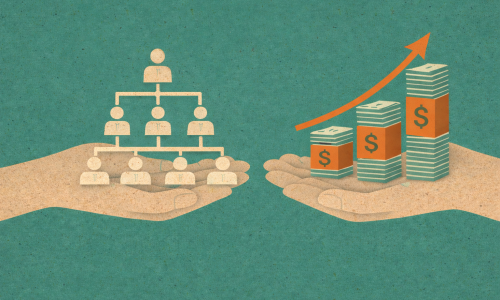
There is an urgent need for new revenue models (a mix of grant, self-generated revenue, and philanthropy). Yet 83% of organizations in Flanders still operate primarily within the "romance-style" funding which relies on grants and private donations. However, the internal expertise to implement this is often lacking. Organizations want to diversify, without really knowing how. Even funders often don't know how to truly put this into practice.
Someone summed it up aptly: ‘Lack of time due to lack of money, lack of money due to lack of time.’ That vicious cycle is the most common reality in the civil society sector today.
"Our dependence on grants limits our choices and where our energy goes. Preparing files..."
"The uncertainty surrounding funding and the lack of decisions, while we as an organization must constantly demonstrate good governance."
“The organizations that will thrive in the coming years are those that dare to rethink their funding mix - regardless of the size of their grants.”
We feel we are not being heard
Perhaps the most troubling pattern: a deeply and widely shared feeling that civil society is not being heard sufficiently at the policy level. Organizations that work every day on issues that deserve policy attention deserve to be recognized as the experts they are.
"A lack of understanding among funders about what works. Decisions based on indicators that don’t measure what they’re supposed to measure, but are easy to measure."
"Not being taken seriously as an expert in your field because you depend on funding. As if you can’t offer expertise just because it concerns your own organization."
"Grants follow measurable actions. Prevention and invisible care are not validated."
The frustration runs deeper than money. Respondents cite token participation, regulations that change without any logic and a sense of mistrust on the part of the government. Terms like “Kafka”, “bureaucratic burden” and “shrinking space” come up repeatedly, signaling that the relationship between the sector and policymakers has not become any easier.
This is crucial: the feeling of “not being heard” also fuels something else. A fighting spirit. Indignation that mobilizes. Many of the people we spoke with are determined to make their voices heard.
"Political agendas and the desire to score political points seem to take precedence too often over actually addressing social problems”
"Civil society organizations face growing pressure to conform, alongside increasing attacks on specific organizations."
The taboo surrounding entrepreneurship is crumbling
From a wide range of sectors and in very different terms, the same message is emerging: the sector is struggling with the idea that entrepreneurship is both possible and acceptable in the civil society sector. More and more people believe it is necessary.
"Entrepreneurship is both possible and acceptable - even in the social and cultural sector"
"Not enough commercial focus. Still too supply-driven."
"The financial side of things, daring to ‘sell’."
At the same time, there is resistance. Fair resistance, in many cases. Respondents warn against the creeping in of economic jargon, against the risk of losing sight of the mission and against the framing of civil society as an entity that “guzzles subsidies.” The tension and concerns are real: organizations that dare to view their services as a product and that treat marketing and sales as strategic tools, are building financial independence.
The third way requires strategic clarity: knowing where your organization stands, where it wants to go and what financial mix fits that vision. That is, especially today, an existential exercise.
"Commercialization, creeping economic jargon, management speak - going along with the framing of the civil society sector as a ‘subsidy guzzler’."
"We must dare to break out of our Western European cocoon. We currently think in terms of grants and donations, but there are much more dynamic concepts in value chains - including profit for non-profit."
The balance of power is shifting (and that’s good news)
Two trends are shaping the future of civil society.
- The current context is forcing organizations to become more professional: in impact strategy, organizational structure, governance and financial management.
- The growth of something that is difficult to fit into an organizational chart. Everywhere we see local initiatives flourishing: citizen groups, neighborhood collectives, action committees, driven by people who pour their energy into what they believe in. Often without a grant application, but with a directness that many established organizations recognize or even envy.
At the same time, there is a human capital crisis that deserves attention. The wage gap between the private and public sectors weighs heavily on the sector. The workload is extremely high. Many people speak of “survival” and “putting out fires.” Finding and retaining volunteers is becoming more difficult because commitment is becoming more fleeting. The search for the right employees with both passion and capacity was mentioned dozens of times as an organizational challenge.
"Civil society is becoming less professional, which is often a good thing. Making a bigger impact with fewer paid staff. That only works if you trust people and give them a say. The shift from ‘volunteering’ to ‘organizing’ has finally begun in Belgium as well."
"Trying to do things the way they have always been done, even though a lot has changed around us. Sensing that an undercurrent is setting a lot in motion,yet still getting stuck in more of the same. Not really daring to take decisive action"
"Nonprofits are undergoing a necessary professionalization: in impact strategy, organizational structure and recruitment. Alongside passion, performance is also coming to the forefront."
“Organizations that succeed in embracing local initiatives without absorbing or overshadowing them have enormous growth potential.”
The Blind Spots
Perhaps the most valuable part of everything we gathered: the answers to the question about blind spots and taboos. Here, the sector speaks out about what often goes unspoken.
Blind Spot 1 - Boxed thinking
“The little finger barely realizes it’s attached to a hand that’s attached to an arm…” That’s how someone described sectoral silo thinking. Letting go of sectoral thinking and working transdisciplinarily: the sector knows this; practice is slow to follow. The same applies to all subsidy-dependent sectors: safeguarding one’s own resources serves the organization, rarely the social goals it stands for.
Blind Spot 2 - Preaching inclusion, practicing exclusion
A painful taboo that was mentioned repeatedly: the sector preaches inclusion to the outside world, while governing bodies and top management are not very diverse. There is a gap between leadership and the diversity of the target group. Someone put it bluntly: “Promoting inclusion and participation as external goals, but doing too little to foster inclusion as an internal goal. As a result, the external goal loses credibility.”
Blind spot 3 - The little kingdoms...
There is a lot of criticism within the sector itself. Nonprofits operate in the same fields without collaborating. There is competition for resources, while a coalition would yield greater impact. Everyone wants to keep their own nonprofit, while mergers or intensive collaboration would be more efficient.
"The hollow desire to collaborate, driven by intense competition for operational funding."
"Over the years, the NGO sector has failed to reinvent itself. Many talk a lot about collaboration... but only on their own terms."
Proving impact is no longer optional
“What is your impact?” It’s the question - from funders, boards, policymakers and increasingly, the general public. Those who can clearly articulate and demonstrate their impact are in a stronger position. Those who lag behind become vulnerable.
There is frustration within the sector itself - about measuring output, numbers and figures while real social change remains underexposed. Meanwhile, organizations honestly admit that they themselves do not collect enough data to substantiate their relevance or that they sometimes simply do not know.
What stands out in organizations that excel at this: they treat doubt as a tool. The question of whether they actually achieve what they claim thus becomes a basis for making adjustments.
"It's difficult to capture the actual impact and truly make it visible."
"Blind spots within organizations: not looking enough at the bigger picture. Often due to a lack of time and an inability to prioritize it."
"A need for a new perspective. Organizations are very attached to the old ways. Society is evolving and it’s a matter of reinventing the mission and interpreting impact differently."
Together, but how?
Political uncertainty, cost-cutting measures, polarization, staff shortages: these are all challenges that no single organization can solve on its own. Yet the instinct to go it alone is stubborn. Behind that instinct lies a painful paradox: organizations that share the same mission are competing with one another for the same scarce resources.
"Low salaries for people who work for a good cause, making it difficult to find qualified staff. Too many charities pursuing the same goal, resulting in a lot of wasted resources"
- S&L ClientShared back offices, joint fundraising campaigns, cross-sector coalitions - the possibilities are endless. So are the obstacles: fear of losing autonomy, competition for limited resources, cultural differences. More and more organizations are overcoming them.
"More and more organizations are coming under financial pressure. They are looking to form coalitions and work together to manage their overhead costs more efficiently."
"It would be interesting to seek out and find more allies beyond the confines of our own sector."
"We are still too hesitant to collaborate: in coalitions, but also in operations and back-office functions. There is much to be gained there."
What do you expect from us?
We asked the same question: what do you value in external coaching? When do you bring it in? What do you expect? The answers were surprisingly unanimous.
1. A mirror
A recurring theme: the value of an outside perspective. From someone who listens, understands and dares to say what remains unspoken internally.
"A coach who tries to understand us and also dares to question things - but above all, tailoring the approach to the organization is the most important thing."
"The ability to identify issues and make them discussable without taboos or baggage."
"Real expertise, solid knowledge! Not a pseudo-coach who comes to ask ‘the right questions."
2. Actionable and practically applicable
What matters is co-creation that leads to an action plan the organization can actually implement. Concrete. Feasible. Tailored. Because: you might as well just ask Claude to put together a slide deck that’s a direct translation of a management book.
"Zooming out and staying on track: where were we again? Which path are we on? Aren’t we going around in circles too much?"
"I don’t like talking just for the sake of talking. It has to lead to something concrete."
3. A partner, more than just a supplier
Organizations want a partner who thinks along with them, grows with them and remains accessible even after the project is complete. Someone who knows their industry - in practice. The desired role is that of a strategic sounding board: someone who helps think more clearly, refine their focus and find the courage to make the choices that should have been made long ago.
"That it’s a genuine partnership and that you don’t get the feeling it’s just commercial guidance."
"It gave us the push to follow through on decisions we had never managed to make internally. The outside expertise carried more weight."
What we believe at S&L
Antonio Gramsci once wrote: “The old world is dying and the new has not yet been born. It is the age of monsters.” We recognize that image. Civil society is in the midst of this period of upheaval: the old models have run their course and the new ones are still taking shape.
We are in the midst of a transition. Transitions are messy, uncomfortable, full of contradictions. At a certain point, the transition demands a choice: letting go of the familiar, embracing the uncertain.
What we see, across all the answers, is that this choice is becoming increasingly urgent. Organizations know they must change. They feel it in their funding, in their governance, in their teams, in their relationship with the government. The act of changing itself (letting go of the familiar, embracing the uncertain) remains the hardest part.
“Determination and inspiration are essential. The next step requires strategy: developing scenarios, assessing our capacity for change - as an industry, as an organization and as leaders.”
In concrete terms, that means: having the courage to lift the hood. At the model level, beyond the mission. How do we generate revenue? How do we organize our people? How do we measure our value? How do we release what no longer serves us, even when letting go is hard?
That’s easier said than done. Saying goodbye to something you’ve built is one of the hardest things there is. The organizations we see emerging strongest from this transition are the most honest ones. They dare to ask the tough questions. They dare to get their hands dirty with new models - funding models, collaboration models, organizational models - even if they’re still under construction. They know that progress begins before the perfect model exists.
We believe that civil society will need more entrepreneurship in the coming years -the entrepreneurship of mission-driven innovation. The courage to experiment. The discipline to measure. The honesty to course-correct. And the connection to do it together.
"The world around organizations is more volatile than ever. Developing different future scenarios helps them prepare flexibly for what lies ahead."
"Changing times are a golden opportunity for many organizations, but they are also a trap that can cause them to drown in the challenges coming their way."
" I see that many organizations are writing about the attacks on civil society with great concern and a fighting spirit. How we can effectively organize, engage in and win that battle is still a work in progress."
This piece is a snapshot. A shared insight at a turning point. The transition is in full swing. But what lies in between - that is where the real work happens.
"Want to discuss this further? Get in touch with Stijn Demuynck: about your organization, your sector or the future of civil society.
Disclaimer - This report is based on conversations, trajectories, and a broad survey among 400 professionals from the civil society sector (autumn 2025)."