
Traditional consultants like to hide behind 'objectivity'. It is one of the oldest reflexes in the profession: the idea that you are there to analyze, to structure, to guide; but not to take a position. As if, as an advisor, you stand on the sidelines. As if expertise exists without values, context, or power relations.
The illusion of neutral advice
Yet time and again it becomes clear how deeply advice intervenes in the world beyond the boardroom. Recent scandals once again make that painfully clear. Boston Consulting Group (BCG) contributed to a financial model for what would later become the infamous ‘Gaza Riviera’ plan: an attempt at population displacement, packaged as an economic development model. Two partners involved were dismissed, but the reputational damage (for BCG and for the sector as a whole) is structural.
McKinsey, now responsible for billions in settlements in the opioid case in the US, spent years helping pharmaceutical companies bypass the addictive properties of painkillers in their marketing. Bain & Company became entangled in a corruption investigation in South Africa surrounding the dismantling of government structures.
“You can't advise Shell and Greenpeace at the same time and claim that you're neutral. Advice is always a choice.”

What stands out: despite these cases, despite parliamentary hearings and international criticism, the sector grows year after year. In 2024, McKinsey, BCG and Bain together generated more than 35 billion dollars in revenue. Apparently, reputation and responsibility are still subordinate to the business model.
The core of the problem lies deeper than one case or one firm. It is the belief - tacit, but widespread - that consulting is ‘technical’. That the consultant is not a moral actor, but a neutral facilitator. PowerPoint over position and analysis over responsibility.
But that picture is, of course, not correct. Those who help define the problem also influence the outcome. Those who structure the conversation steer the thinking. And those who select options influence what remains unthinkable. Consulting is therefore always performative: it makes something possible, or rules something out.
“Advice is always performative: it makes something possible, or rules something out.”
The Bermuda Triangle of Talent
The belief that advice is neutral does not live only among clients. It is also systematically passed on to young professionals entering the sector. What begins as a calling (‘I want to make an impact’, ‘I want to help think through solutions’) too often ends in cynicism, burnout, or moral paralysis.
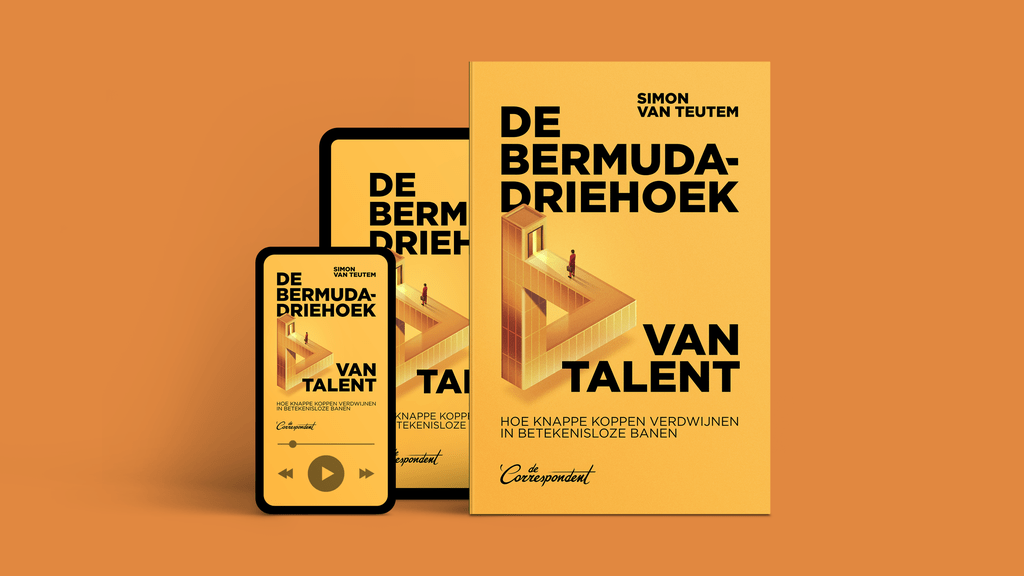
In The Bermuda Triangle of Talent journalist Simon Van Teutem shows how promising young people, often with a strong social drive, are recruited after their studies by prestigious consulting firms that combine their skills in the name of scale, efficiency, and above all: shareholder value. The three forces that subsequently engulf them are recognizable and powerful:
- The performance fetish: everything revolves around hours, targets, and KPIs. Time for reflection or moral consideration? Not factored in.
- The profit logic: if the project contributes to revenue, then it is legitimate. If the client pays, it is good.
- The status illusion: the name of the firm (and the CV effect) legitimizes the rest. Anyone who works for an ‘MBB’ (The Big Three or MBB refers to management consulting firms McKinsey & Company, Boston Consulting Group, and Bain & Company) has little need to ask themselves further questions.
What remains is a generation of consultants who excel at problem-solving thinking, but have less and less insight into the moral nature of the problems they are helping to address. The result is not a major scandal, but something more insidious: professional apathy, loss of identity, an underlying sense of ‘not doing what you came to do’.
What this 'Bermuda Triangle' makes visible is that ethical failure in consultancy is not only a matter of wrong choices at the top. It is also a structural problem of training, incentives, and professional culture.
That is both uncomfortable and hopeful: it shows that another practice is possible; provided that we organize, value, and pass it on differently.
Four systemic blind spots of neutrality
Anyone who wants to understand the ethical vacuum in consultancy should not only look at assignments gone off the rails or rogue partners. The question is not why some consultants go astray, but why entire organizations remain systematically blind to the moral significance of their work.
What at first glance appears to be a lack of courage or reflection is in reality often embedded in the structure of the model itself. Consultancy is generally organized around mechanisms that reduce moral complexity to contractual efficiency. In such systems, ethics are not avoided out of unwillingness, but out of habit.
It is not the people who fail first, but the logic in which they operate. What is rewarded determines what is seen. And what is seen determines what may be discussed. This creates a culture in which ethical questions only emerge when it is already too late. And in which principles do not provide direction, but are used afterwards to repair reputations.

We analyze four structural mechanisms that sustain this blindness: not as an indictment, but as an invitation to redesign.
1. Partner autonomy: whoever sells, decides
Most strategy and management consultants work with a partner system. Those who become partners share in the risk and the profit, but also gain considerable freedom to bring in their own clients. That sounds logical. But it also means: the commercial driver and the substantive direction often coincide in one person.
We saw what that produces in the BCG-Gaza case. According to the Financial Times, the project was never formally approved by the central risk or ethics committee. Two partners set it up without the green light - but also without significant internal opposition. Because the system is built on trust between peers, not on transparent moral assessment.
At S&L, we work in a fundamentally different way. We are a partner organization, but without individual portfolios. Clients are chosen in consultation, assignments are collectively weighed. We make conscious choices about which trajectories we do or do not engage in. In our selection, we do not apply a purely commercial logic: we test every request against our mission, our expertise, and its societal relevance. This means that we reject some requests: not out of convenience, but out of consistency.
2. Price incentive: every project becomes an opportunity
The average daily rate at the major strategy firms ranges between 2,000 and 3,000 euros. In some cases, this rises to ten times the monthly salary of a junior in the public sector. That price dynamic creates a perverse urge to frame every problem as both complex and solvable.
Because how else do you justify such budgets? By showing that you solve something the client could not solve themselves: preferably something that seems large, intangible, or urgent. The result: structuring above context, analytical power above ethical awareness.
S&L therefore applies strict price ceilings, avoids strategic upselling, and ensures transparency about margins: both internally and towards the client. Where possible, we align billing with actual deployment, although in some forms of work, such as interim assignments, that remains a balancing act between a pre-agreed commitment and realistic deployment.
3. Moral licensing: a good project as an ethical indulgence
One of the most undermining mechanisms in consultancy is moral licensing: the idea that harmful assignments are offset by also doing something socially valuable. Today a strategy for the fossil fuel sector, tomorrow a pro bono trajectory for an NGO, and the moral balance appears to be restored.
But ethics are not about offsetting. Making amends is fundamentally different from doing good.
At S&L, we do not apply an ethical indulgence model. Pro bono work is always done out of conviction, never as compensation for other assignments. Every assignment (regardless of the financial framework) must in itself demonstrate coherence between purpose, impact, and societal relevance.
We work from ongoing assessment: does this trajectory contribute to the society we want to help shape? Does it strengthen the sector? Does it promote justice, structural sustainability, and public legitimacy? Only then does advice emerge that truly makes sense. In its design, execution, and meaning.
4. Client dependency: the price of the loyal relationship
Perhaps the most persistent pitfall: client dependency. The longer you work with an organization, the harder it becomes to say no. Not only financially, but also relationally: you build trust, know a great deal, and are often an integral part of decision-making.
And so the question "Do we still want to do this?" is gradually replaced by: “How do we guide this as well as possible?” Even when the direction feels uncomfortable. Even when doubt increases.
In the public sector, this becomes even more precarious. Consultants are often hired there without market testing or real alternatives. The reflex to continue assignments blindly is then all the stronger. At S&L too, we recognize that risk. Some relationships have grown historically and are intensely intertwined with how we work. That makes it harder to start the conversation about relevance, distance, or transfer. We try to actively name that dynamic, remain critical of long-term collaborations, build in exit strategies, and, if necessary, allow ourselves to be replaced if we feel that we no longer provide added value - or are no longer the right mirror.
These four blind spots are not exclusive to the 'big players'. They also creep into small-scale, values-driven consultancy. That is precisely why it is necessary to name them and actively organize against them. Not once. But structurally, collectively, and with public accountability.
Does such a thing exist: an ethical compass for consultancy?
If consultancy is rarely neutral - and is structurally embedded in logics of profit, status and dependency - can there even be such a thing as a moral compass?
The answer is: yes. But only if we build it explicitly. Not as an after-the-fact check or reputation shield, but as an integral part of the way we advise, choose and collaborate. Not as an ideal, but as a working structure.
The good news: practice shows that it can be done. Not easily, but it is achievable, provided there is a willingness to take a position, be transparent and structurally reorient. We list 4 practices below.

The principle of 'we advise everyone' is not sustainable.
Client refusal as a core competence
A growing number of consulting firms are beginning to abandon the principle of ‘we advise everyone’. The international initiative Clean Creatives has by now brought together more than a thousand advertising and PR agencies that consciously refuse assignments from fossil fuel companies. Not out of idealism alone, but as a strategic signal: those who refuse take a position. What this expresses is not arrogance, but coherence. And that is precisely what is missing in much consultancy logic.
At S&L Strategies and Leaders we adopt a similar stance, albeit in our own context. We sometimes say ‘no’ to requests that come our way. Because they run counter to our mandate. Because the assignment is incoherent with the societal impact we seek to achieve. Or because we feel that our presence would not strengthen the process, but depoliticize it.
Refusing is not a luxury. It has become a core competence. It often earns respect, including from those we refuse. Yet refusing is not self-evident, especially not in a market system where revenue equals success. That is why we advocate methods that structurally facilitate refusal, such as:
- A Red-Line Matrix*: a public overview of sectors, regimes or practices you will never engage with. Think of gambling companies, temp agency arrangements in healthcare, greenwashing campaigns or policy communication without a citizen process.
- An Impact Clarifier: a fixed exercise before submitting a proposal, in which the consultant (and client) clarify the societal consequence of the assignment. Consequences? Affected parties? Alternatives?
Refusing becomes easier when it does not feel like a judgment, but like an agreement about the playing field in which you want and are able to contribute.
Giving direction without dominating
A second pillar of an ethical compass is the way you give advice. In many traditional processes, the consultant is the one who leads the conversation, writes the summary, and puts the ‘decision options’ on paper. The tone is set by whoever facilitates.
That is not problematic in itself, but only if you acknowledge that this is power. And therefore: that it requires responsibility.
At S&L, we believe that giving direction is possible without overpowering, provided you make it transparent. And that you leave room for alternative voices, tempos and perspectives.
We therefore work with principles such as:
- Organizing dissent: we involve not only the board and management, but also target group representatives, employees or external sounding boards in workshops. Sometimes as a ‘disruptive voice’, sometimes as a co-decision-maker.
- Publishing impact logs: after every intensive process, we map out what was advised, which values were taken into account, and which choices were made explicitly (or implicitly). Not as accountability, but as an invitation to reflection - also for the client.
Giving direction then becomes not hidden influence, but a shared process.

Organize your own dissent.
Rewriting incentives
An ethical compass is not just a matter of individual integrity - it lies in the structures that steer behavior. As long as revenue, utilization and customer satisfaction are the indicators of success, moral reflection remains peripheral information. That is why it is essential to also rethink the incentive systems within consultancy.
In B-Corp-certified consulting firms, experiments are already underway with bonuses based on external value creation: CO₂ reduction among clients, social added value, transparency in decision-making. At S&L too, we strive to link recognition to the quality and societal relevance of the work, although this is not yet structurally embedded in our current internal operations. At the moment, recognition is primarily linked to commitment and availability - something we as a collective still want to grow in.
“An ethical compass is not a matter of individual integrity alone - it lies in the structures that guide behavior.”

Those who exert influence on organizations and policy bear public responsibility.
Public accountability: ethics as infrastructure
Ethics requires not only internal awareness, but also external scrutiny. Some Scandinavian agencies show that it can be done: they publish an annual Ethics & Clients Report, in which they make transparent which assignments were refused, what considerations were involved, and what lessons they drew from them.
Others work with an independent ethics board, with real authority: vetoes on dubious deals, termination of collaborations, and a mandate to tighten policy.
Transparency confirms the legitimacy of advice. Those who, as consultants, exert influence on organizations and policy bear public responsibility. That responsibility deserves a robust ethical infrastructure: based on conscious choices, shared reflection, substantive scrutiny, and clear accountability.
A strong ethical compass creates room for consistency, moral craftsmanship, and sustainable positioning. It makes advice not only substantively strong, but also socially meaningful. In the interaction between strategy and justice this compass determines the direction: advice as a lever for fundamental change.

What can clients do?
Building an ethical compass is not a one-way street. Clients also play a decisive role in shaping the advisory relationship. Not by placing themselves morally above the advisor, but by creating conscious frameworks in which moral craftsmanship has room to flourish.
Too often responsibility for ethics is projected entirely onto the agency. “Surely they should know what is acceptable?” But in reality, many important choices are made implicitly during the intake phase, in the budget discussion, or through what is and is not specified in the brief.
Organizations that want advice to strengthen their mission—without ignoring the moral undercurrent—can make a difference through four concrete interventions.
1. Ask about the Red‑Line Matrix
The simplest way to know who you are bringing in is to ask: what do you refuse to do on principle?
Does the firm have a list of sectors, regimes, or types of assignments they exclude? Why or why not? How do they deal with borderline cases?
What often meets with resistance at commercial firms (“we work for everyone”) is an important starting point in mission-driven sectors. As a client, you show that it is not only the final report that matters - but also the process, the mandate, and the context.
At S&L, we use our own red-line logic as a selection mechanism: if we cannot justify a project internally, we do not start it. We hope that clients look at their external partners just as critically. But at S&L, too, this remains a search.
2. Build a ‘Values Brief’ into the tender phase
In the classic tender, the focus is on deliverables: action plan, expected output, working method. What is rarely asked is how the advisory process relates to the organization’s core values - and how choices along the way are tested against the mission.
One possible practice to strengthen that awareness is the introduction of a ‘Values Brief’: a short document in which the consultant - in advance - explicitly sets out:
- How this advice serves the organization’s mission
- Which moral tensions may arise
- How these will be dealt with during the process
Such a brief does not have to create extra paperwork. It is a thinking exercise, and at the same time a test: will this advisor get to work with more than just content?

How does the advisory process relate to the organization’s core values?
At S&L, we do not yet use this format systematically, but we consider it a valuable direction. In many of our projects, this alignment already takes place in intake conversations or start-up workshops - informally, but essentially. A more structural approach, such as an explicit Values Brief, could strengthen this process and make it shareable within the organization.
3. Provide for a learning contract
Most consultancy contracts are static: once approved, they remain untouchable until the end. But strategic processes are rarely linear. Sometimes the situation changes along the way. Or the assignment creates friction in ways that were not anticipated in advance.
A learning contract formally provides for interim evaluation moments at which both parties can make adjustments: or even decide to stop. Not as an escalation, but as a normal part of professional collaboration. In this way, ethical reflection becomes a structural element, rather than an emergency brake.
4. Compensate reflection
What has no budget rarely gets attention. Yet many clients expect ethical reflection to ‘happen alongside the work’. While in reality it takes time: preparation, consultation, allowing doubt, working through scenarios.
By explicitly providing a number of hours for moral consultation (internally or with the consultant), you as a client send a clear signal: this is part of the work.
Moreover, you create a space in which the advisor also dares to speak freely: about what feels wrong, about unforeseen impact, or about questions that fall outside the technical assignment but are crucial to the legitimacy of the process.
As a client, you determine not only the assignment, but also the moral framework within which advice is developed. By explicitly choosing reflection, positioning, and testing, you give the profession back the depth it deserves, and needs.
MBA programs present ideology as rational lawfulness.
Toward an advisory sector that makes the world better
The structural errors in consultancy begin upstream. In the MBA programs and business schools that for decades have preached the idea of profit maximization as an economic law of nature. Not as ideology, but as rational lawfulness. Not as an opinion, but disguised as science.
The consequences are well known: consultants are shaped as technocrats of efficiency, not as guardians of the social fabric. As the open letter from Otti Vogt to the global business academy puts it sharply:
“You taught profit über alles not as ideology, but reason. What you call value creation is too often value extraction.” - Otti Vogt
As long as those frameworks of thought remain dominant, consultants will continue to structure their assignments around cost-benefit analyses, optimization, and shareholder return, even when this causes social harm.
But in the meantime, the counter-narrative is also growing.
More and more students are avoiding the classic ‘big names’. They do not want to become part of a system in which reputation is structurally disconnected from ethical behavior. A new generation is emerging that does not see impact as a marketing label, but as a moral commitment.
Within the sector too, niche firms and value-driven consultants are moving toward a different model: slow, transparent, relational, and critical. Processes in which what counts is not the billing rate, but the extent to which the work resonates socially. Clients are joining them. They do not want ‘advisors for everything’, but partners with conviction. Not neutral fixers, but conscious allies.
And that momentum for ethical craftsmanship, that is now.

Consultancy legitimizes its position only by making it explicit.
Advice is always a position
We can only conclude this newsletter with a simple but all-defining sentence: Advice is always a position.
Those who advise make choices. Not only in what they say, but also in what they do not say. Not only in which report they write, but also in which voices they do or do not allow to be heard. Consultancy is never value-free. And so its legitimacy does not lie in concealing that position, but in making it explicit.
You can provide advice in the shadow of power, or in the light of public responsibility. You can contribute to optimization processes, or help recalibrate what truly matters. You can say that you are ‘neutral’, or acknowledge that you have influence, and use it carefully.
At S&L Strategies and Leaders we choose the latter. Not because it is always easy. But because it is the only way to take ourselves, our clients and the sector in which we work seriously.
Any questions?
Would you, as an organization or as a board, like to reflect on ethical decision-making, advisory relationships or power dynamics in strategic processes? We would be happy to think along with you.
Feel free to contact Aurélie De Cock, Koenraad Depauw, Jeroen Robbe, Benno Schiffer, Jef Van den Bergh, Barbara Creemers or one of our other colleagues at https://www.s-l-impact.com/team
* Note. A Red-Line Matrix is not actually a fixed model that exists everywhere in the same form, but rather a practical and public overview of exclusion criteria: sectors, actors, regimes, practices, or forms of cooperation with which an organization will not engage as a matter of principle. It is both an ethical compass and a communication tool that guides choices in strategy, partnerships, funding, and communication. Because there is no universal model, this is often implemented through exclusion policies (banks, investment funds), ethical guidelines (NGOs, consultants), or ESG screenings (companies).










