Homaar
Drawing on their experience in child and adolescent psychiatry, two therapists chose a different path from traditional clinical care. They left their jobs and founded Homaar vzw. Six years later, this small, welcoming space for young people was thriving—but its future remained uncertain.
Demand from other provinces was high, and the founders faced a difficult choice. Should Homaar expand across Flanders? Others wanted it to—but what did they themselves want?
With support from Siska and Koenraad, the founders made strategic decisions together, combining head and heart. But S&L also rolled up its sleeves, helping Homaar secure funding and guide a merger.
The client
Homaar vzw offers accessible support to young people in the Ghent region who are struggling emotionally. It provides a warm, welcoming space where they can reconnect with themselves and discover their talents.
The question
The organisation receives more referrals than it can handle, and everyone—including politicians—is full of praise for its work. There is just one problem: no existing grant framework fits this kind of initiative. Homaar therefore depends on donations, creating constant financial pressure.
The founders draw most of their energy from their therapeutic work with young people. But securing a financially sustainable future seemed to require expanding Homaar across Flanders. They felt genuine enthusiasm for that possibility, but also uncertainty—and a fear that growth might make the organisation too large, too ‘professional’ and less warm and welcoming for young people.
The impact
Together, we clarified the impact Homaar wanted to achieve and developed a strategy, implementation plan and timeline to make it happen. Throughout the process, we paid particular attention to the motivation and energy of the two founders. We also coached them during implementation.
We began by speaking individually with every team member and board member. This gave us a clear understanding of the organisation’s culture and people’s commitment to change.
Working with a core group of four colleagues and one board member, we defined the collective ambition and developed an impact strategy to bring it to life. This was not an abstract strategy disconnected from practice, but a practical action plan with a clear timeline.
Along the way, we also pursued several valuable side routes. For example, we quickly developed a legal structure that would make scaling easier—either by merging with emerging initiatives in other regions or by establishing new teams with their own funding.
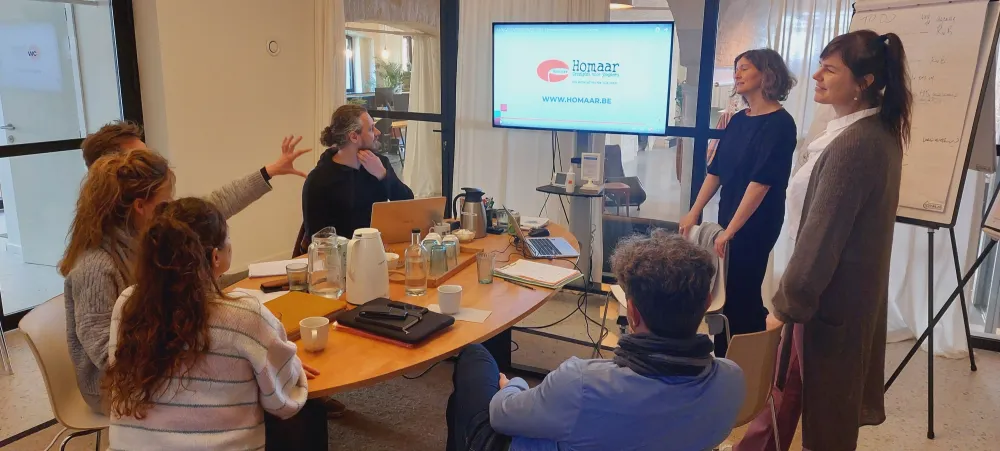
As is often the case, the biggest breakthrough did not lie in the external impact goals the organisation had set. We took a deep dive into Homaar’s business model and finances. By identifying the right levers, we were able to make substantial progress.
Throughout the process, we involved Homaar’s board and decided to include Vonk vzw, its partner in Antwerp, fully in the journey. We guided the development of a shared governance structure, addressing everything from group dynamics to the articles of association. We also helped Homaar establish relationships with public bodies and policymakers in its search for stable funding.
Fifteen months after our support began, Homaar had teams in East Flanders, Antwerp and Brussels, with a new team being established in Flemish Brabant. In a short period, it had already doubled its reach and impact among young people struggling emotionally.
The challenge
When our work began, Homaar had few certainties. Its funding was insecure, the building housing its activities was temporary, and its previous location had burnt down. Yet Marieke and Nathalie remained calm. Homaar would not exist without these two remarkable women. They remain central to the organisation today and will continue to be so for the foreseeable future.
The founders’ vision and charisma have repeatedly helped them find funding—or even inspired a generous supporter to make a new building available.
We faced two major challenges during the process. The first was developing a strategy centred on impact. On paper, that was not particularly difficult. The real challenge was determining whether the strategy could be implemented successfully, given the founders’ strengths, energy and motivation.
The second challenge was moving quickly from abstract strategy to concrete action. Strategic work requires abstract thinking, but if you remain at that level for too long, people can begin to lose faith in the process.
“Given Homaar’s strong start-up energy, it was important to make things practical quickly. We kept the momentum high by moving early to establish a shared governance structure.
”
The collaboration
It was a joyful collaboration. We often ate cake together and even took a road trip to Antwerp. Between sessions, Homaar colleagues regularly dropped in for an hour of advice on the practical challenges they were facing.
Now that the strategy is in place and being implemented successfully, we meet every two months to discuss the smaller challenges that arise along the way.
One for the road: tips from Marieke Degryse, co-founder of Homaar
- Do you have big dreams but wonder whether they are achievable? Make your BHAG—your Big Hairy Audacious Goal—your ambition.
- Set aside enough time to work through the process together as a core team. It is intensive, but well worth the effort.
- S&L adapts to your needs and questions. Be clear about what you want to explore in greater depth—and what you would prefer to leave aside.
Homaar had support of these team members
Does this case appeal to you?
We would be happy to discuss your organisation’s specific needs. Two of our consultants will meet with you to explore your request and develop an initial proposal. Based on your feedback and further co-creation, we will then prepare a final proposal.