One of the the clearest examples A prime example of how erratically change unfolds over time is the introduction of the right to vote. When Belgium was founded in 1830, the census suffrage system was in effect: only anyone who was wealthy enough (and a man) was allowed to vote . In 1893, after years of struggle, it became multiple general voting rights introduced for men. Wealthy and highly educated men were still granted an additional vote. It was not until 1921 that universal suffrage for all men was established, and equality for women was not achieved until 1948. So it took more than fifty years for the change to truly take hold. Every step was imperfect , but always of great importance.
Meet Bill
Policymakers tend to stick to their routines , because that seems to be the safest option. And usually, a call for change is initially championed by a a very select group of people . At the same time, there are always others, often wielding significant economic or institutional power, those who stand to benefit from things staying the way they are . The policy will therefore aim to business as usual to continue.
Until a window suddenly swings open . An alternative that once seemed experimental has suddenly become the new standard in a short period of time. Behind that apparent coincidence lies a pattern that you can analyze and understand.
Bill Moyer was involved for many years in campaigns aimed at social change. He saw how activists and progressive organizations struggled to understand change. Moyer developed, with his Movement Action Plan not only an analytical tool for understanding the path to change, but also a resource for anyone who wants to gain insight into how they can contribute to that change.
This exercise begins by asking three questions:
- What percentage of the population recognizes the problem?
- What percentage of the population sees the connection between current policy and that problem and therefore opposes that policy?
- What percentage of the population supports the alternative movement?
There will always be there are more people who recognize the problem than there are people who actually hold the policy responsible. And even if someone criticizes the policy, it’s not yet certain whether they actually support your alternatives. Whatever your topic may be, answering these three questions will give you a better understanding of where you stand, how far is the road to change regarding your topic? is and what you have to do today.
We’ll take a closer look at Bill Moyer later, but the questions he raises remain relevant for organizations seeking structural change. They shed light on where a movement stands today and what it will take to move forward. You'll discover what leverage you can use , and how success can be measured.
In addition to a shared analysis of the problem and support for change, it is important to note that there is there are various theories about how change comes about . At the heart of every theory lies a different mechanism that you can incorporate into your strategy.

“New practices drive social norms forward. Shifts in norms open up new opportunities for policy. And policy changes, in turn, make alternatives scalable and sustainable.”
Some people believe that change is the result of a battle between elites . You can then focus on regime change or on convincing or persuading your elite to support that change. Others believe that structural change is the result of a sufficiently large critical mass that embraces the change . Awareness campaigns are therefore a logical choice. Still others believe that change is the result of creating sufficient and sustained pressure from below . In that case, organizations focus on political education, mobilizing, and organizing a growing base of supporters. No matter which theory you subscribe to, explain exactly how you should respond to this. .
Social change thus becomes not just a matter of hope or momentum, but a an area where a deliberate strategy , power and the ability to learn make all the difference. Do you just want to get started right away? Then download our social change model tool .
TLDR;
- Social change is unpredictable, but it is not random. What you do can help determine both the direction and the depth of change.
- Change occurs when three factors reinforce one another: growing support for change coupled with increasing opposition to a policy, policy windows that open up—often as a result of mounting pressure—and alternatives that demonstrate that a different model works.
- Policy shifts happen slowly, until suddenly a breakthrough occurs. Movements gain ground when they mobilize resources, recognize and capitalize on opportunities, strategically build power, and tell a story that provides direction.
- Power takes many forms in this context: building coalitions, broadening and strengthening one’s base, pushing through decisions, adapting rules, redesigning structures, and shifting meanings. A strong strategy consciously chooses which forms of power to build, bundles them into a portfolio, and maintains a rhythm that balances moments of escalation with moments of absorption.
- A scorecard makes it clear where you can focus your efforts and what’s at stake: Is criticism of current policy growing in intensity, is your power base expanding, and are alternative policy options ready to be implemented?
What do we mean by social change?
Social change has three distinct areas of impact that constantly influence one another.
- Normative Shifts : What people take for granted changes. Ideas that once seemed fringe gradually become conceivable, sensible, and desirable. Example: the smoking ban in cafes and restaurants. When it was first proposed, it seemed controversial. Today, most people consider a smoke-free restaurant or bar to be a matter of course.
- Institutional and Policy Changes : Formal rules, programs, and budgets influence and shape the behavior of citizens, organizations, and businesses. One example is the introduction of the mobility budget and the shift toward greener company cars. Policy decisions regarding taxation and incentives are steering the behavior of employers and employees en masse toward more sustainable transportation choices.
- Material Alternatives : New products, services, and organizational models demonstrate in practice that a different model is viable. Consider, for example, the rise of energy cooperatives such as Ecopower Citizens' Cooperative . They make renewable energy accessible and affordable for citizens, demonstrate a working model of collective ownership, and thereby strengthen the broader energy transition.
These three domains interact with one another in a cyclical manner. New Practices advance social norms. Shift in Standards opens up new avenues for policy. And policy changes ... and then make alternatives scalable and sustainable.

Political scientists such as John Kingdon have clearly described this mechanism in the Multiple Streams Framework , in which problems, solutions, and political momentum converge as soon as a policy window opens. At the same time, Baumgartner and Jones, among others, remind us that policy rarely evolves in a linear fashion: long periods of stability are repeatedly interrupted by brief, intense moments of breakthrough, which they punctuated equilibrium mention.
If social change thus arises from a dynamic interplay between norms, policies, and alternatives, the question arises: how exactly do ideas and behaviors spread throughout a society? How does a small group reach a tipping point that carries the larger whole along with it? And: How large should this (small) group be? ?
Diffusion ≠ Advertising Campaign: On Barriers, Networks, and Social Reinforcement
Humans are social creatures: we exist only in relation to others. Both the way we view the world and the way we behave arise and evolve within a community. People change when their environment sends signals that make the change seem meaningful and achievable. The more often those signals recur across different relationships, the greater the likelihood that behaviors or beliefs will shift.
Threshold Behavior
Everyone has their own threshold for taking action: some people jump in as soon as one person sets an example, while others wait until they receive confirmation several times from their immediate circle. Small shifts in that distribution can trigger a cascade in which an entire group shifts at once. Mark Granovetter’s classic threshold model shows just how crucial that distribution is for collective change.
Research (by Damon Centola) shows that behavioral change spreads more quickly and sustainably in networks where people repeatedly receive confirmation from multiple contacts. Overlapping and clustered networks thus serve as the driving force behind structural adoption. Hold that thought.
The rate at which behaviors spread often follows an S-curve. Innovations start slowly, accelerate as social reinforcement kicks in, and stabilize once a majority has been reached. Everett Rogers’ diffusion theory emphasizes that the characteristics of the innovation, the social context, and the costs of adoption determine how fast the curve rises.

“Overlapping and clustered networks are the driving force behind widespread adoption.”
Effective change (therefore) requires redundant confirmation. That means investing in overlapping clusters so that multiple networks transmit signals simultaneously. It also requires rituals and recurring moments that keep behaviors visible, repeatable, and socially appealing. Digital channels are helpful when they strengthen existing relationships—not as a separate communication channel, but as an extension of what people do together.
Once behaviors and ideas begin to spread through networks, pressure is building on the political and institutional environment . Still, that’s only part of the story. Social change only takes root when policy adapts as well. So the key question is: how Does Policy Really Get Moving? ?
From Opportunity to Breakthrough: How Policy Drives Change
Policy rarely changes in a straight line. It usually proceeds through long periods of stability, interspersed with brief moments when a window of opportunity opens, making rapid breakthroughs possible. Political scientists have developed various frameworks to understand this process and provide a framework for strategy.
- Multiple Streams: John Kingdon shows how policy shifts when three currents converge: a problem which is widely recognized, a solution that's ready to go, and a political momentum in which decision-makers are willing to invest. When these three factors align, a policy window opens and change can be implemented quickly.
- Punctuated Equilibrium: Baumgartner and Jones emphasize that policy often gets bogged down in routines until a shift in focus or framing suddenly upsets the balance. This is followed by brief periods of rapid reform: the so-called “punctuaties.” Such leaps are usually preceded by signals indicating that the existing approach is unsustainable.
- Advocacy Coalition Framework: The framework emphasizes coalitions of actors who share common beliefs. They influence policy over the years by nurturing ideas, testing them, and institutionalizing them step by step. This gives rise to long-term processes in which coalitions learn, reach compromises, and gradually bring about change.
- Hegemony: Antonio Gramsci described how power structures are inherently conservative and, above all, defend certain interests. They form a coalition (a so-called hegemonic bloc) that presents the status quo as natural and self-evident and seeks to generate broad social acceptance. Groups that wish to raise an issue must forge their own coalition—one that forms a counter-hegemonic bloc and seeks to establish a new narrative. There is a constant struggle between the blocs, and systemic change at the policy level is usually the result of a shift in the composition of the dominant, hegemonic bloc.
Policy changes typically require a multi-track approach. While a movement works to spread awareness and build momentum, it is crucial to develop policy options and secure early buy-in from key stakeholders. Meanwhile, coalitions must be robust enough not only to force a breakthrough but also to consolidate it as soon as a window of opportunity opens.
The Flemish concrete ban illustrates that interplay largely: land-use pressure and climate awareness were on the rise; policy options had been laid out for years in studies and reports; and a coalition of civil society and experts ensured that the issue made it onto the political agenda and was able to hold its ground despite fierce opposition.

“When policy changes, it is rarely the result of a single action or a single group.”
Finally, it is important to point out what Bill Moyer describes as trigger events : Suddenly, something happens that causes all the spotlights to shine on a single issue, and large groups that are normally reluctant to get involved feel compelled to take action. An example is the rise of Black Lives Matter following the acquittal of the police officer who killed Trayvon Martin . Other Black victims of police violence who were killed in the years that followed provided new catalysts that strengthened the movement.
Momentum often comes and goes suddenly and quickly. Strong organizations prepare for the possibility of such a moment in order to make the most of it and bring about the greatest possible change.
When policy changes, it is rarely the result of a single action or a single group. Breakthroughs occur when social movements succeed in organizing their resources, timing, and narratives in such a way that they maintain momentum. What is the difference between a trend that fades quickly and a movement that brings about lasting change?
4 Types of Muscle Strength
How does a movement prepare itself so that it actually takes advantage of those opportunities? Four elements interact in this process:
- available resources and structures ( resource mobilization ),
- understanding and using opportunities in the area ( political opportunity structures ),
- a story that clarifies the problem, the solution, and the moral ( framing ),
- and organizational depth that helps members grow into agents of the work ( deep organizing ).

Each element contributes a different kind of strength; the combination determines the overall impact. This mutual reinforcement becomes evident in the following case studies:
The American civil rights movement linked church communities and training programs to a moral and legal framework, allowing resources, opportunities, and narratives to reinforce one another. In Ireland, years of relationship-building and preparatory advocacy led to a constitutional referendum on same-sex marriage opened, just as the political and social context was ripe ( political opportunity ). Black Lives Matter the prevailing view shifted from isolated incidents to a structural pattern, making new coalitions and policy paths credible ( framing ). Closer to home, the Ghent's Traffic Management Approach how a clear target architecture, broad coalition-building, and carefully chosen timing lead to structural shifts in mobility and the experience of the city, with lasting effects on traffic and public opinion (resources and organizational depth that capitalize on opportunities).
Designing for practical application (of change) begins with four Specific Design Questions .
- Which resources and infrastructure what do you need to make your next decision, and who manages them?
- Where and when are realistic openings in the political and social landscape , and what do these signals indicate?
- Which story ensure that target audiences and decision-makers share the same definition of the problem and the same approach to the solution—and who can communicate that in a credible way?
- Which structures help members and volunteers grow , take responsibility and ensure that knowledge is retained, so that energy doesn't flow away after peak periods?
You measure progress through related indicators in each element: stability in staffing and budget, better access to key arenas and agenda-setting opportunities, adoption of your framework by quality media and authoritative actors, and visible growth in leadership and ownership among members. When these indicators all rise simultaneously, the likelihood increases that you will be able to turn the next policy window into tangible change.
The American scholar and organizer Marshall Ganz offers some helpful insights to help you muscle strength to train and deploy them as effectively as possible as an organization. The most important thing is his definition of “strategy”: how to turn what you have into what you need to get what you want .
You always start with something. The key question is how to use what you already have today as effectively as possible to build power that you’re still lacking today and that you need to contribute effectively to change. In this regard, Ganz also highlights the importance of “resourcefulness”: the ability that allows you, as an organization—even if you have less initial clout than an opponent—to still make a difference.
The extent to which organizations invest in developing that ingenuity and making the best use of limited resources, determines strategic capacity and, ultimately, the likelihood of success for organizations.
Power is multifaceted: approach it that way, too!
Once your goal, target audience, and timing are clearly defined, a key question arises: what kind of power are you building, through what relationships, in what arena, and with what signs of progress? A useful way of looking at things combines three perspectives that reinforce one another.
- The effects lens identify exactly what you want to change: direct pressure on decision-makers, rules and procedures, underlying dependencies, or the meanings and norms that are taken for granted (Read more: compulsory, institutional, structural, productive – Barnett & Duvall). Example : The elimination of the housing bonus in Flanders illustrates how an institutional effect can reshape policy rules and tax structures while simultaneously influencing expectations in society.
- The source lens identifies the sources of your power: reputation and appeal; connection power, which enables you to build broad networks or focus specifically on influential contacts; expert power, which builds on your thematic expertise, knowledge of the right channels, frameworks, and decision-making opportunities; or even positional power, which stems from a formal position and mandate. In addition, as an organization, you may also have little or a great deal of disruptive power: the ability to make the existing state of affairs more difficult or more expensive, thereby creating a dilemma for policymakers. Example : during the COVID-19 crisis, Sciensano was able to influence policy decisions by combining its expertise, institutional mandate, and reputation. The legitimacy of its data and recommendations served as a decisive source of influence.
- The arena lens identifies where you work and how visible that is: decision-making, agenda-setting, or meaning-making, in closed, invitation-only, or self-claimed spaces, and at the local, regional, national, or transnational level. A concrete application of arena thinking can be found in a model that invites us to define “win” goals, “build” goals, and “shape” goals for each campaign. Building on insights about power from Gramsci and Lukes, among others, we see how there is an arena where decisions are made—this is where you win or lose . In addition, there is an arena where the agenda is set—this is where you either gain or lose the opportunity to turn your alternatives into policy options—and finally, an arena where it is determined what is possible or even conceivable. That last arena is the most challenging, and it is here that the (far) right has dealt decisive blows in recent decades that have severely weakened the progressive agenda. Example : the PFAS crisis involving 3M in Zwijndrecht illustrates how an issue can shift from local and closed-door decision-making to national and European arenas,
Using those three “lenses,” you’ll begin the actual design process:
- Anyone who bets on decision-making effects first, select the decision-maker and the calendar portal and set recognizable “asks” that increase in significance. Power mapping, a negotiation path, and a rhythm of public and relational moments make the pressure visible. You can gauge progress through agenda items, hearings, motions, public expressions of support, and shifts in the positions of key actors.
- Who institutional securities at the same time, it is developing a solution that is manageable: legally sound, cost-analyzed, and accompanied by an implementation plan. Indicators of this include draft memoranda, proposed laws or regulations, standards, budgets, and new procedures.
- Structural effects focus on the underlying infrastructure of the problem: supply chains, financial flows, procurement criteria, and governance. Typical strategies include investor engagement, procurement standards, and industry agreements; indicators include revised contracts, capital allocation, and new market practices.
- Discursive Effects you do this through narratives, stories, and iconic practices that shift the framework of what is conceivable. You monitor word choice and problem definitions in quality media, public statements by authoritative figures, and changing public norms. Creative campaigns and smart marketing can make all the difference here.
Please note. The link between sources and effects deserves explicit attention.
- Expert knowledge and legitimacy lend weight to institutional processes.
- Attractiveness, reputation, and the power of connections ensure that movements grow and gain momentum.
- And managing access, costs, and risks serves as the catalyst for structural change.
By specifically identifying those connections, you can prevent too much pressure from being placed on a single source. It highlights where gaps exist: when expertise relies heavily on reputation but lacks relational access , when a reputation is widespread but lacks institutional support, or when an opening on the agenda exists but there is no direct pressure.
The value of a power portfolio only truly becomes apparent in specific cases. The global divestment movement targeting fossil fuels began with a shift in discourse : Climate change was framed as both a moral and a financial risk. That framing opened the door to investment committees and led to structural shifts in capital flows. This was later followed by institutional anchors in the policies of universities, pension funds, and cities. Smart actions, including a significant “naming and shaming” component, have helped ramp up the pressure along the way.
The #MeToo process followed a different sequence but was based on the same principle: a massive discursive redefinition of acceptable behavior , reinforced by public mobilization and pressure, followed by institutional changes to codes and procedures, and finally, structural incentives through insurers and industry standards.

Closer to home, energy cooperatives demonstrate how member capital, local legitimacy, and technical expertise work together to open up institutional access. Thanks to participatory models and credible solutions, citizen collectives gained access to licenses, concessions, and public contracts in which citizens' ownership was fully recognized.
Measuring progress is a direct result of this design:
- For decision-making and keeping track of the schedule helps maintain a systematic log of contacts, commitments, calendar events, and changes in positions.
- At institutional pathways these include the status of proposals, legal review, budgetary coverage, and the governance of implementation.
- Structural Goals these issues involve monitoring contract values, investment criteria, supply chain changes, and new standards.
- Discursive Effects are revealed through media analysis, support from influential actors, audience measurements, and qualitative feedback from target groups.
Shaping Together these four lines form the backbone of a scorecard that makes it clear whether the initiative is making progress and where adjustments are needed.
The order in which effects unfold often proves to be decisive. Many issues gain momentum when a discursive foundation is first established that provides legitimacy and a common language. At the same time an institutional path is being laid out that is manageable and concrete . Meanwhile, we are building relationships with decision-makers and identifying structural levers that can bring about lasting behavioral change.
In that cycle, each effect reinforces the next, and the sources continue to grow as a result of visible success. The rhythm is not a detail of execution, but the mechanism through which power builds up and continues over the long term.
Movement in Phases and Roles: Mobilize, Legitimize, Embed
Every movement that achieves results goes through recognizable phases and assumes different roles along the way. Smart organizations respond to this by making an analysis of where they stand on the issue the core of their strategy. Bill Moyer describes eight phases in his Movement Action Plan. If you zoom out a bit, you can see them as three phases: development, breakthrough, and consolidation (Moyer).
In the development phase awareness grows and the first networks begin to form after an initial group identifies a problem and repeatedly brings it to people’s attention. That first phase is extremely important, because it’s where you lay the foundations on which you’ll build later. At the same time, it can be frustrating because you initially have no power and your voice is largely unheard.
During the breakthrough phase attention suddenly spikes, leading to a surge in mobilization. This is often a “make or break” phase, in which organizations must shift their focus from criticism to getting people on board—both in criticizing the policy and in supporting the alternatives you’re proposing. Organizations that invest in strategic capacity during the build-up phase are more effective at capitalizing on momentum and securing concrete victories once the peak has passed.
Because “reaping change” is what happens in the anchoring phase that follows the peak. Then, provided the right strategic choices are made, you have the opportunity to secure majority support, make policy decisions, and implement them—often amid resistance and adjustments. Between these stages lie hurdles that teams can anticipate and plan responses for.
Rollers that support each other
Four Archetypes keep coming back: the Rebel that highlights the urgency and shines a spotlight on the problem, the Reformer who guides these solutions through institutions and works to bring about change through established channels (ranging from lobbying to legal proceedings), the Organizer that recruits members, trains volunteers, builds and helps raise awareness of support, and the Citizen which enshrines the social norm.

Each role contributes in a different way and takes the lead at different stages. A sense of urgency without an organizational backbone quickly fades away ; an organization that does not adapt to changing public norms lacks legitimacy; institutional processes stall without a sustainable foundation. Teams that explicitly define roles reduce the internal tensions inherent in the different natures of various roles and consciously plan their interactions in a strategic manner. A day of action requires Rebel energy; the following week involves Organizer work to engage new people , at the same time, the Reformer keeps the negotiating channel open, and the Citizen role ensures daily normalization in the media, various sectors, and neighborhoods.
Gemini: Escalating and Absorbing
Any surge in attention and mobilization will only have an effect if the movement simultaneously invests in sustaining that momentum. Escalate it means ramping up pressure: a mass movement, an action, or a campaign that sparks public debate. Or planning more forceful follow-up actions if policymakers fail to respond. Absorb means transforming the energy of that moment into sustainable strength: welcoming new people, assigning roles, training leaders, and nurturing relationships.
Without that second track, energy disappears just as quickly as it arrived. With absorption, a stable foundation grows, middle management emerges, and the movement gains memory .
A practical rhythm also helps balance both tracks: think in cycles of six to twelve weeks ( Momentum ). First comes a warm-up phase in which the problem is framed and relationships are strengthened. This is followed by a public moment with clear demands that peak attention and make pressure visible. Finally, a period of consolidation follows: discussions, training sessions, and the distribution of responsibilities to ensure that new participants remain engaged and experienced members advance into leadership roles.
Escalation becomes meaningful when a specific decision point is in sight and the grassroots know what comes after the peak. In this way, an action becomes not only a signal to the outside world, but also an investment in the movement’s internal strength.
Design by Phase
- In the construction phase the focus is on defining the problem, with small but repeatable actions, micro-conversions, and the formation of local hubs. Here, measure relational growth above all: how many new contacts become active participants, how many people take on their first task, and which stories resonate.
- During takeoff it’s all about rapid scaling and visibility, with clear value propositions and easy-to-understand entry roles. Success is measured by participation rates, media reach, and the number of new teams that remain active after the peak period.
- During the phase of majority support the focus shifts to legitimization: coalitions expand, expertise becomes visible, and access to policy channels is gained. This includes statements of support from authoritative actors, hearings, draft policy documents, and cooperative government agencies.
- At decision and Implementation discipline takes the place of spectacle: solution designs, budgets, pilot routes, and monitoring. Indicators include formal decisions, budgetary coverage, agreements, and initial implementation results.
- Next comes consolidation : safeguards against backsliding, institutional embedding, and data-driven adjustments.
Common Pitfalls (and How to Avoid Them)
A classic gap is the “ perception of failure ” Shortly after takeoff: media attention is waning, your latest initiative drew fewer people than during the recent peak, and internal pressure is mounting. Teams that anticipate this plan a consolidation package in advance, with specific roles and learning objectives.
A second pitfall is role dominance : A movement either remains in Rebel mode or stays in technocratic Reformer mode. An explicit role calendar prevents overload and keeps the portfolio in balance. The third pitfall is a pace mismatch : escalation without a decision point or negotiations without a foundation. A shared timeline for policy, public events, and organizational growth keeps the rhythm on track.
The global student climate strikes in 2018–2019 marked a clear turning point. Where local teams simultaneously set up training programs and engaged families, schools, and neighborhood groups, the mobilization lasted longer and opened up access to policy arenas. In Belgium, this resulted in Tournée Minerale A different pattern: annually recurring rituals fostered social cohesion and shifted the norm surrounding alcohol consumption, creating space for employers, healthcare providers, and the media to support the change. In cities such as Ghent the implementation of the traffic plan demonstrated how institutionalization works: institutional decisions, rapid and visible changes in the local environment, and active communication made it easier for larger groups to embrace the new norm.
Language, Frames, and Audience Architecture: Broaden the Window
The rhythm of a movement only gains momentum when language and public architecture (etc.) the way in which, as an organization, you want to reach people and gradually engage them and bring them into your story) expanding the scope of what is conceivable . Frames shape how people view a problem, which solutions seem credible, and what attitude feels appropriate. A simple guide can help: identify what’s at stake, define the desired standard in concrete terms, and show how participation is both safe and meaningful.
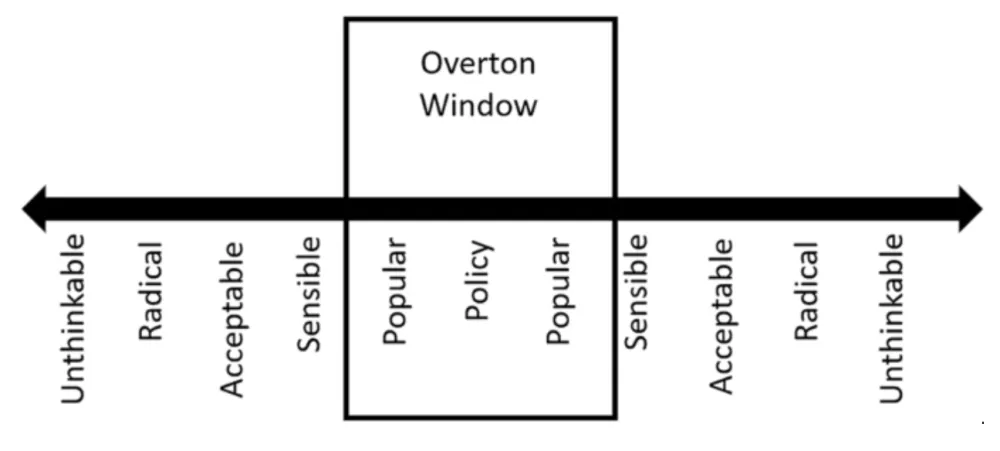
- The Overton Window makes this practical. Ideas shift from the unthinkable to policy when, step by step, they begin to sound recognizable, sensible, and necessary (Overton). But this works both ways. over the past two decades, the (far) right has been more successful than progressive movements in pushing their ideas from the realm of the unthinkable into policy, even without being part of the government. Communication and real-world examples work together to drive that movement forward. A pilot project in the real world that clearly works provides a concrete framework.
- The range of allies apply that to target groups: opponents, the undecided, bystanders, supporters, and allies each take small steps forward when they receive a tailored message with an appropriate invitation. That requires a strategic and segmented approach where you don't try to reach everyone with a campaign, event, or communication, but effectively engages specific target audience segments to build support for your story.
A major mistake here—as is often the case in strategic work—is that we forget we’re not the only players with an agenda. The number of people we can attract to our cause will therefore also depend on who has the best strategy.
Pour them another round!
The introduction of reusable cups at events in Flanders evolved from a niche practice to the norm: first through high-profile pilot programs with clear hygiene and logistical guidelines, then through storytelling and visual imagery centered on clean celebrations and local pride, and finally through regulations that enshrined the new standard.

The framework emphasized values that resonate widely: caring for one another, efficiency, and pride in one’s own city. Measuring this is simple: count the number of times the frame is adopted in quality media, statements of support from prominent figures, public opinion polls on acceptability, and the growth of practices that make the frame tangible. And even more shocking: this summer, tests were conducted using cups without deposit.
Measurement, learning, and mandate: be specific
What can I plan for tomorrow? Try adding a phase assessment to your file: where are you now, what hurdle lies ahead, and which role requires the most attention right now? Determine the next public event and the corresponding “engagement package.” Set up a simple scorecard for your campaigns that helps you define the right themes and objectives. By “right,” we mean: themes that resonate deeply and have broad support, while taking your strategic capacity into account. This will maximize your chances of success.
Here are a few elements you can include in that scorecard: the potential to broaden and strengthen your base of support, public visibility for the issue, the presence and strength of potential coalition partners, institutional access, and an assessment of resistance and willingness to implement.
Also, define measurable goals so you can track your progress and evaluate it both during and at the end of the campaign, and use that information to make strategic adjustments. You can gauge the growth in the strength of your membership base by the number of active members (track new members recruited during the campaign and the retention of existing members), new “leaders” or “super volunteers,” and the stability of local chapters.
Public visibility is evident from reach, repeat engagement, and frame adoption in the media. Institutional Access you can gauge this through agenda items, hearings, draft memos, and the positions of key actors. Implementation Signals include decisions, budgets, contracts, and preliminary results data.
EXAMPLE Take the file healthy school meals . The scorecard tracks, in a relational format, the number of schools with core teams, the percentage of families who enroll through peer referrals, and the growth in the number of student ambassadors.

- In the public line monitor your media framing on health and equality, as well as annual participation in trial weeks.
- In the institutional line track your draft memos based on three criteria: budget levels, legal feasibility, discussions with education networks, and feedback from government ministries.
- In the implementation line measure your pilot results in terms of health and participation, procurement pathways involving local kitchens, and cost per meal.
Measuring helps you ethical (and therefore public) mandate . A movement that explicitly articulates its definition of the problem, its choice of target groups, and its power structures takes responsibility for the world it helps shape. This requires clarity regarding values, transparency regarding resources, and openness regarding unintended consequences.
A change process that takes into account different forms of power, segments of the public, and the lived experiences of those carrying out the work strengthens legitimacy. Insights thus become both a moral obligation and a strategic advantage: data keeps us on course, stories make the direction tangible, and small iterations keep everyone engaged.
S&L, Partner in Change
At S&L, we have extensive experience in supporting organizations that want to take the lead in driving social change.
We support in developing a smart and adaptive strategy that focuses on building power, developing smart campaign strategies, and engaging the base ( supporters, members, or volunteers ), building stronger coalitions or refreshing your tactical and action arsenal . Also, if you have questions about policy advocacy , vision development, or impact measurement you can contact our specialists.
We'll help you come up with a practical plan , provide support with implementation where needed, and help you develop a deeper understanding of how social change works and how you can best respond to it.
Interested? Be sure to contact Jeroen Robbe koenraad Depauw , Ike Teuling (S&L Belgium) and Bér English and Meike Baretta (S&L Netherlands).
This article was previously published in Impact Insights from S&L.