Coalitions are one of the most powerful ways to achieve a major social goal. They bring together organizations, networks, and people around a shared ambition. Yet many of those involved find coalitions to be complex. As a result, the question of how to develop a clear strategy for an existing or new coalition is being asked more and more often.
Our experience from dozens of projects has shown that a coalition strategy requires a different, more comprehensive approach than a traditional strategy project involving a single organization. In a coalition, there are many more perspectives, interests, and working styles at the table. Without clear agreements, a flood of ideas quickly emerges, lacking a common thread.
Coalitions operate differently from organizations
A coalition differs fundamentally from an organization. Its formal structure is often loose, leadership emerges informally, roles are not fixed, and information circulates in a fragmented manner. In such a context, collaboration requires extra attention and care.
The biggest hurdle usually lies in implementing the chosen course of action. Who has the time and authority to put the strategy into practice? What resources are available? How do agreements within the coalition relate to the strategies and plans of the participating organizations?
When executive teams come on board later, or when partners differ significantly in size, organizational culture, and pace, tensions rise. In the background, there are divergent views on change and on how to organize it. Discussions about the “right path” to impact influence relationships and trust.
At the same time, the potential remains significant. A well-functioning coalition reinforces the narrative surrounding a social issue, builds a broad coalition, and creates a level of impact that individual organizations rarely achieve on their own.
“The biggest hurdle usually lies in implementing the chosen course of action.”
Typical Starting Situations
In our practice, we generally see two types of initial situations.
1. The Vibrant Coalition
Some coalitions are just getting started or are making a fresh start. Energy levels are high; people want to get to know one another and find their place in the group. The forming phase is clearly evident: enthusiasm and initiative arise spontaneously, while direction and structure are still taking shape. Our role is to establish a rhythm, channel that energy, and focus the discussion on concrete results.
2. The Weary Coalition
Other coalitions are experiencing burnout. Uncertainty about roles and expectations has sparked conflicts. Struggles for leadership have weakened relationships. Different styles or strategies have come into conflict with one another. There is a growing tendency to judge each other’s approaches, while the focus on mutual reinforcement is fading. In coalitions like these, the guidance focuses on restoring trust and creating new breathing room for the group as a whole.
In both situations, the quality of the relationships is the key prerequisite for any strategic exercise.
Tension Hidden Beneath the Rug
A strong coalition strategy grows out of mutual connection. Choices take on meaning when people get to know and appreciate one another—both as individuals and as organizations. Strategy takes shape within a social fabric and is underpinned by trust.
That’s why we create moments when participants reveal something about themselves that rarely comes up in a traditional meeting: small, authentic glimpses into their motivations, boundaries, and expectations. That openness makes it possible later on to make difficult decisions.
When tensions run high, there’s one clear step to take: we need to call out the elephant in the room. By acknowledging the conflict, we create space for a new conversation. If the tension remains swept under the rug, the coalition continues to be built on shaky ground, and any agreement will easily fall apart at the first sign of trouble.
The day of the heidag: so much more than just one intense moment
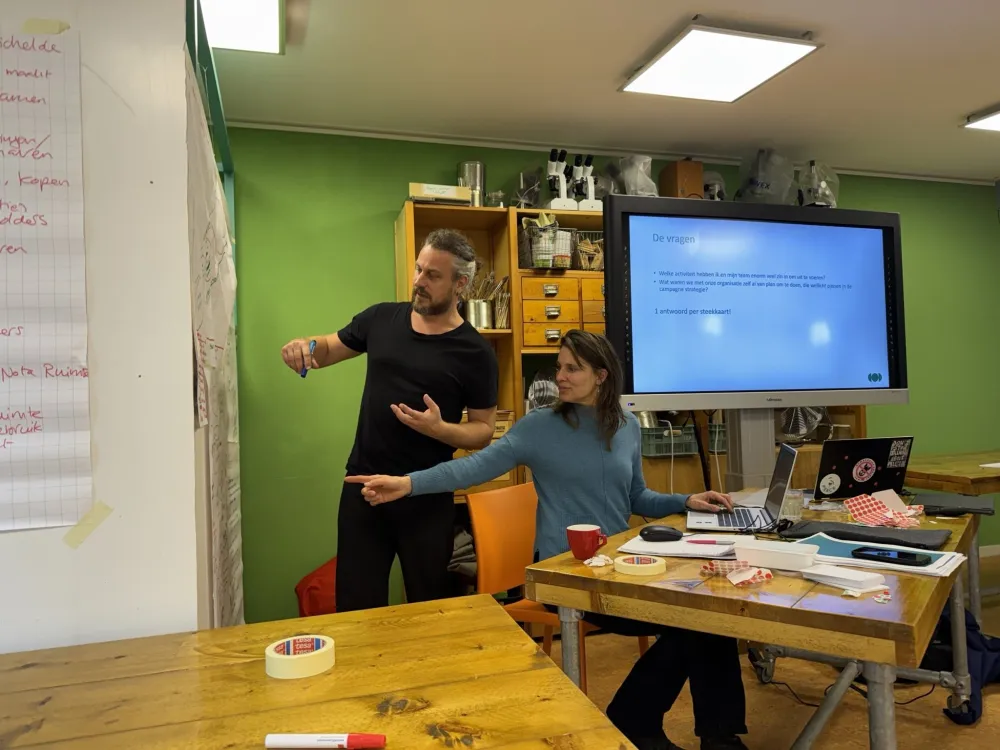
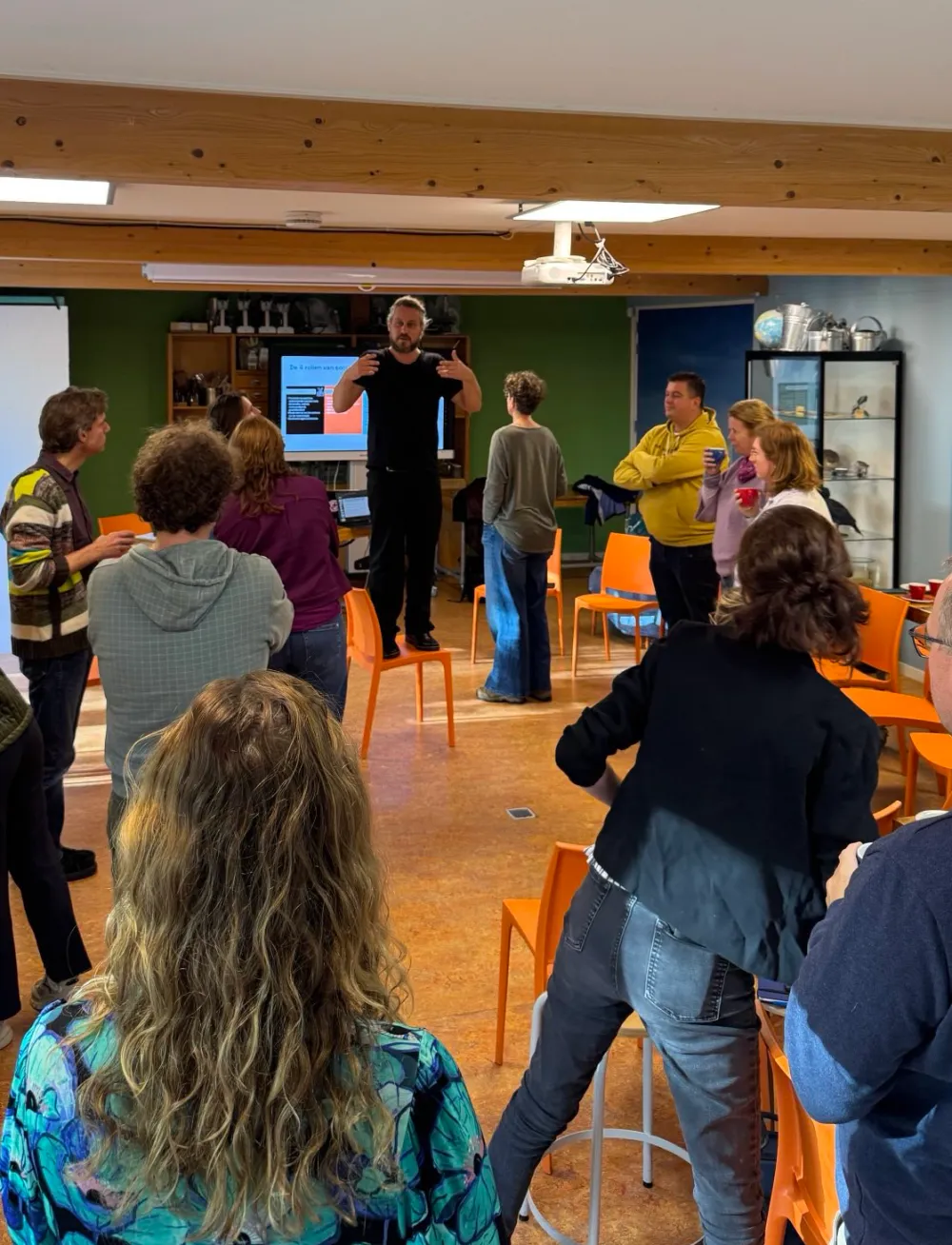
In practice, coalitions rarely set aside much time for strategy. Often it’s just one day, sometimes even half a day. In the Netherlands, this is called a “heidag”; in Belgium, there’s no set name for it. That limited time frame is understandable: everyone’s schedules are already full. At the same time, developing a complete strategy in a single day is an ambitious task.
That’s why our support begins weeks before the actual strategy day. We gather input through one-on-one conversations, digital questionnaires, and exploratory discussions with key players. This helps build a solid foundation of content and context well before the day itself.
During the strategy day, we will focus on two core tasks:
- Fostering Creativity and Highlighting Connections
- Exploring Possible Directions and Shared Priorities
We work with formats that allow for broad thinking while also encouraging clear choices. A key question in this process is: What truly inspires us when we work together?
After the heidag together with S&L, we develop a concrete proposal. This usually results in a limited number of clear scenarios that the coalition can respond to. The approach remains fast and agile, while we remain mindful of the risk of limited buy-in. That’s why we actively engage as many people as possible throughout the day and ensure that topics that generate a lot of enthusiasm are also prominently reflected in the strategic options.
“Choices take on meaning when people get to know and appreciate one another—both as individuals and as organizations.”
The Real Issue: Structure and Mandate
In many projects, the substantive strategy is put on paper relatively quickly. The real work begins with the formation of the coalition .
A few key questions keep coming up:
- Who takes on a leadership role, and what does that look like?
- Which decisions do we make together, and which decisions does the leader make?
- What happens when time pressure or external pressure increases?
- How does communication work between management teams and among teams?
- How do you involve people who weren't at the table but will be helping to implement the strategy later on?
We see some striking examples of this. In one coalition, hundreds of emails are exchanged each week, while in another, a shared Teams channel remains empty. In both cases, information gets stuck.
That is why we often follow up the strategy day with specific design recommendations : achievable agreements on roles, decision-making, consultation structures, and communication. This provides the strategy with a solid framework for implementation.
Strategy is a collaborative effort
Strategy within a coalition rarely develops in a linear fashion. A clear document is helpful, as part of a larger whole. Strategy comes to life in meetings, discussions, efforts on the ground, and in the way people exercise leadership.
For us at S&L, facilitating a coalition is one of the most demanding types of work. At the same time, we see time and again the potential that arises when organizations join forces around issues such as climate change, health in the Global South, biodiversity, rights for undocumented people, or the fight against the far right.
Coalitions are difficult. But when they work, they're the most powerful thing there is.