You make theater. You build exhibitions. You program concerts and dance on the world’s leading stages. And in the meantime, you write in your policy plan that you want to contribute to a more inclusive model of society, to democratic imagination, to closing the gap between those who belong and those who are left out. That is no modest ambition. It is the ambition of society as a whole.
The question you are better off asking honestly than avoiding is this: how does that ambition relate to what you do every day? A theater auditorium is not a policy instrument. An exhibition does not solve segregation. A dance company does not rectify structural inequality. And yet arts organizations, one by one, have chosen precisely these kinds of ambitions. Art is the means; the world is the field of work.
That deserves respect. And it requires a strategy that matches the scale of that ambition.
“Only variety beats variety. Anyone who wants to tackle something multifaceted must also approach it in a multifaceted way.”
Problems that belong to everyone and to no one
Anyone who places the missions of arts organizations side by side discovers that, across disciplines and cities, they respond to the same social diagnosis. Society is becoming fragmented. Inequality is increasing. Cultural hardening erodes the ability to live and think together. Those who have no access to places of imagination and debate miss something essential.
These are not small problems. They are what organizational studies call complex issues or wicked problems: problems that seem to belong to everyone and to no one at the same time. There is no clear owner. There is no single cause. There is no moment when you can say: it is solved.
These issues are difficult because they are complex in at least four ways at once.
- Substantively: no single discipline has the answer on its own.
- Socially: dozens of actors with contrasting interests and views are involved, at every scale.
- Contextually: even those who are morally and analytically sharp are surprised by shifting power relations, cultural diversity, and system boundaries that are constantly moving.
- And psychologically, because anyone working with such issues is inevitably confronted with a fundamental lack of controllability and knowability. You cannot fully know it. You cannot fully make it. That is uncomfortable, and you cannot organize that discomfort away.
Temptations that do not reach far enough
When organizations engage with such issues, they almost automatically fall into familiar patterns. Each of these patterns contains something true, and precisely for that reason each pattern is a trap.
The first temptation is to adopt the issue as if it were your own problem. You roll up your sleeves, take concrete steps, do what you can. That is sincere and has value. Soon afterward, the feeling arises of fighting a losing battle: you do something, it remains too little, and you know that yourself as well. The reflex to make complexity manageable, to translate it into actions within your own horizon, makes thorny issues even thornier. Managing complexity away is postponement.
The second temptation is to place the responsibility elsewhere. With the government. With the sector. With a coalition, a platform, an initiative that still has to be created. You need others, that is true. The reasoning gets stuck as soon as it becomes clear that oversight is lacking everywhere: with you, with the government, with the parties to whom you delegate. Centralizing merely shifts the illusion of control.
The third temptation is broad consultation. Leaving your island, bringing all perspectives together, everyone at the table. That sounds good. The pitfall is that consultation becomes an end in itself. Platforms multiply, tables are filled, working groups report to steering committees, and meanwhile the issue persists. Integrated coordination suits clearly defined issues. In the face of multiple complexity, it strives for one shared answer to a problem that consists precisely in its plurality.
The law at play here is that of the British cyberneticist Ross Ashby: only variety beats variety. Anyone who wants to tackle something multiple must also approach it in a multiple way. That is not a quick process. It is a steady, disciplined, and sometimes uncomfortable process.
“A rhizome has no beginning and no end; it always moves between things, connects, splits, branches. Everything is interconnected, but not through a center.”
The rhizome as a countermodel
At S&L, we sometimes work with metaphors. The dot on the horizon. The compass. The tree: roots as the foundation, a trunk as the core, fruits as the result. These are useful images for issues that are clear enough to be approached in this way.
For tough, multifaceted problems, they fall short. And the reason is deeper than methodology. The tree is not just a useful image; it is a way of thinking. A way that is deeply embedded in how Western organizations, institutions, and intellectual traditions structure reality. Philosophers Gilles Deleuze and Félix Guattari already analyzed this in the 1970s: tree thinking forces reality into vertical structures. There is a core, a hierarchy, a center from which everything is made understandable. Rationalizing, centralizing, standardizing: they are all expressions of that same tendency to tame complexity by ordering it. And that tendency, they argued, is not neutral. It excludes what does not fit. It makes the world more understandable by making it poorer.
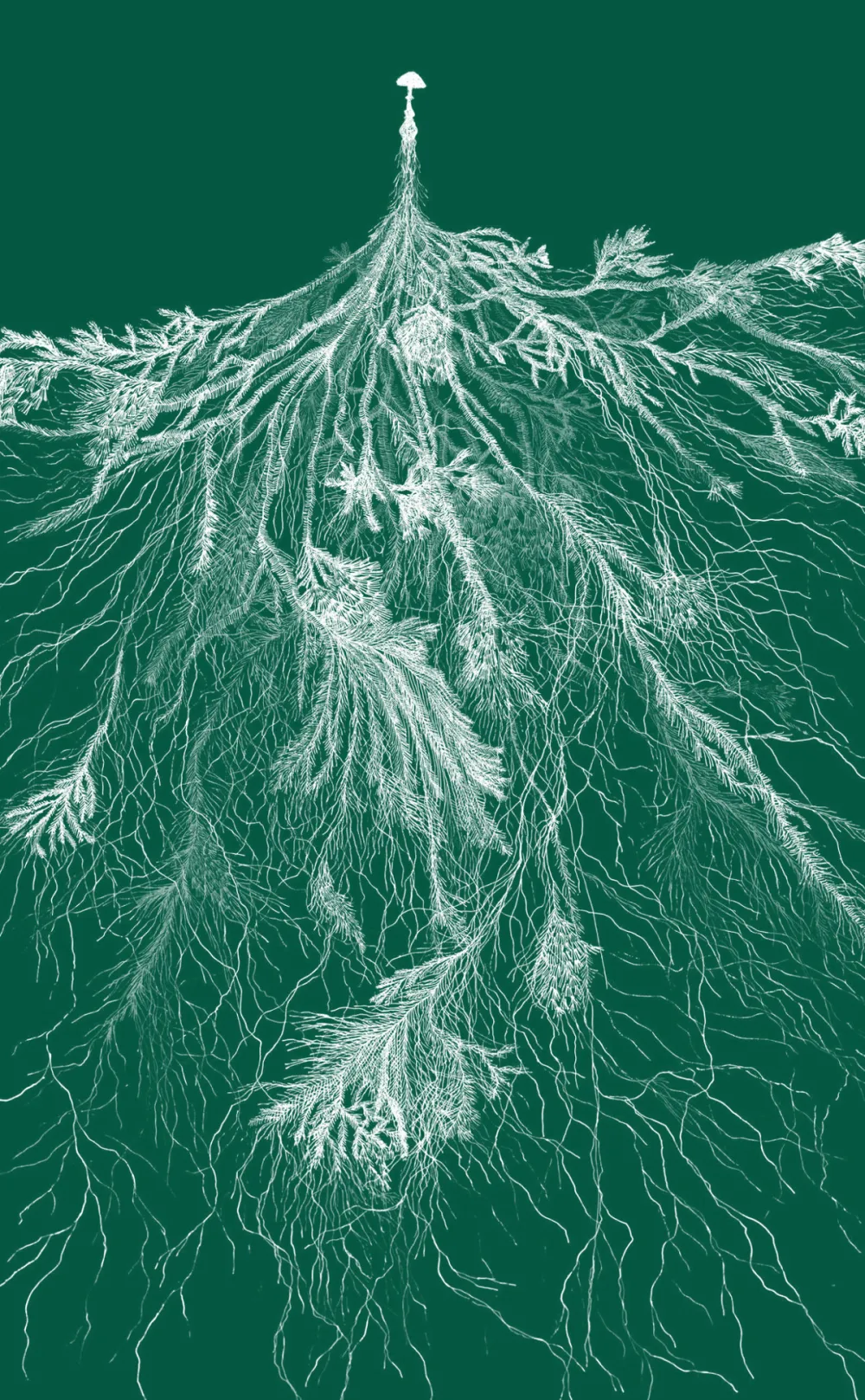
Their alternative was the rhizome: the underground network of a fungus. Connections that proliferate, grow where opportunities arise, find new paths when old ones become blocked.
A rhizome moves between things, connects, splits, branches out. There is no beginning or end. Everything is connected along a thousand threads at once and rarely in a straight line: an intervention in one place has effects in places you can hardly identify in advance. Center, essence, and standard are absent. The forms it takes are heterogeneous, unexpected, different every time. Leadership circulates; every voice speaks from its own position. Under pressure, the rhizome bends, seeks new paths, grows around obstacles. It has something inevitably opportunistic about it. The map it makes of reality always remains temporary: meaning emerges along the way, written anew each time.
That is a fundamentally different logic from the tree. And for organizations working on tough societal issues, it is a more honest logic.
“The value of local practice—what actually happens in the theatre, in the exhibition, in community work, or in the concert hall—can hardly be overestimated.”
Contamination as strategy
Anna Lowenhaupt Tsing puts it in a memorable way in her beautiful book The Mushroom at the End of the World. How does a society become an event, more than the sum of its parts? Her answer: through contamination. We become contaminated by the encounters we have. We change who we are the moment we make room for others. Purity does not exist. The key to survival is change.
Contamination sounds uncomfortable. But that is precisely the point. Tsing uses it to describe a reality that cannot be engineered, is not fully knowable, and cannot be controlled, but is richer and more robust than any centralized strategy could ever produce. Those who change through the people they meet, who do not cling to their identity but allow it to merge through interaction: that organization is resilient in the best sense.
For Dutch arts organizations that want to have social impact, this has a concrete meaning. The value of local practice, what actually happens in the theater, in the exhibition, in community work, or in the concert hall, can hardly be overstated. It is the only place where you can truly act, slow down, learn, and create depth. That is your core, and you must take it seriously.
But the strategy that goes with it does not begin and end within those walls. It requires connection: diverse, targeted connections with actors who are far enough removed from you to give you something new. Not the fixed circle, not the familiar partners from the same sector. Research consistently shows that meaningful shifts often happen through weak ties, through people with whom you do not have a close bond. The care institution you have never called. The community worker who does not know your programming but does know your audience. The urban planner who thinks about the same streets as you, but from a completely different logic.
Connection thus becomes not a side activity. It becomes the work. It becomes the shape of your organization.
How do you build a strategy tailored to your ambitious challenges?
The question then is: how do you organize yourself so that connection work is not the exception, but a structural practice? How do you look at your territory, the city, the neighborhood, the field, as a living network instead of as a defined area of operation? How do you strategically select whom you seek to connect with, and why? And how do you keep those connections productive; heterogeneous, multiple, not fixed on a single shared answer?
These are questions that we at S&L are eager to explore, together with organizations that carry precisely that ambition: to think big about social change, while also being honest about the limits of what you can achieve alone.
There are approaches for this. A way to build your strategy as a rhizome rather than as a tree. A way not to choose between the local depth of your own practice and the breadth of the connections you need. A way not to fear contamination, but to organize it. Hans Vermaak wrote a clear book about this with “The Logic of the Patchwork Quilt” (Boom, 2025).
We are happy to share that approach. But it begins with the question every organization must first ask itself honestly: who has truly changed you in recent years? And whom have you changed by being who you are? The answer to that question says more about your strategic health than any policy plan ever could.