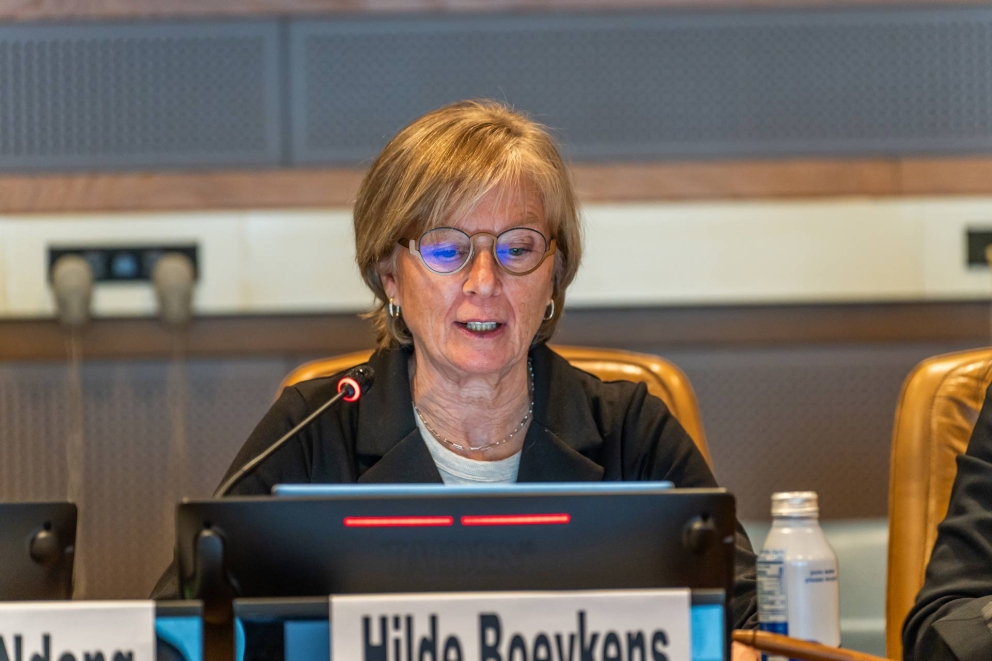
I spoke with Hilde Boeykens, Director of SOS Children’s Villages, and Christel Smedts from S&L, an expert in team and organizational development and leadership coaching.
Hilde, your organization is quite well known, but could you still refresh our memory about what your mission is and how you translate it into practice?
Hilde: An organization active in Belgium, linked to a worldwide federation in 138 countries that provides care for children in difficult family situations. We provide direct care and stand up for their rights by influencing and changing laws and systems. Partly because of the refugee crisis in 2015, we started providing shelter for unaccompanied minor refugees. That was certainly a shift in focus.
Did that crisis also require shifts in how you operate?
H: Children in Belgium who experience terrible things at a young age often suffer trauma through the relationship with their direct caregiver. For refugee children, the trauma is threefold: from the country they are fleeing, from the escape route where horrific things happen, and when they are received here, because that is not with open arms. At their core, they are the same as a target group, but certainly more complex.
And so has your assignment also become more complex?
H: It has always been twofold: influencing policy and having our feet on the ground. To do the former in a well-founded way, practical experience is indispensable. Conversely, change is also needed at the system level if we want to see structural improvement for the target group and maximize our impact.
Last summer, due to circumstances, we said goodbye to our director in Flanders and the pedagogical director. That happened very suddenly and caused turbulence in the team and the projects.
Christel: In the care sector, people truly work with heart and soul. Employees feel enormously connected to the mission. That is why there was so much emotion around the departure of those profiles.
And did SOS Children's Villages have the expertise in-house to deal with that turbulence?
H: I quickly decided not simply to replace those directors, but to build in a period of reflection. For that, I looked for external support — someone with knowledge of the sector, but also of our specific situation. An interim profile who had a feel for the team and culture.
“Her view of our organization is and remains that of an outsider, however involved she may be. She can stand both inside and outside at the same time and thus help us best.”
Ch: If you hire someone new without reflection, without processing what came before, you are actually asking too much. With such a sudden departure, it is wise to opt for an interim period, because something like that seeps into the walls of your organization, especially if it is given no time or space.
And then Christel from S&L was brought on board for a while to guide you through that period?
H: We also spoke with the large, typical agencies that offer interim solutions, but there was no right connection and I missed experience with the sector. At S&L, we immediately noticed a thorough understanding of our question, and that creates trust. Rightly so, as it turns out, because our employees immediately felt the same trust with Christel. They really dare to make themselves vulnerable, which is necessary in order to deal with this organizational trauma.
Ch: People dare to be honest, they feel at ease. I am not there to evaluate them, but to help the organization heal toward the future. We do not heal organizations; they do that themselves. With our help. Healing always happens from within. My position is to make vulnerability possible, while also being a firm voice that sets clear boundaries.
“In the event of a sudden departure, it is wise to opt for an interim period, because something like that seeps into the walls of your organization, especially if it is given no time or space.”
Do they accept those boundaries from someone doing interim management?
H: Those boundaries don’t feel threatening, because of Christel’s personality, but also because of the temporary nature of her position. Her view of our organization is and remains that of an outsider, however involved she may be. She can stand both inside and outside at the same time and help us in the best possible way.
Ch: I am certainly involved, through experience, because of my past, but I can also step back out at any time. That way I maintain the systemic perspective, I can see patterns and dismantle their negative impact. Finding the right balance in your involvement is an exercise that is truly central to this assignment, so I also want to set a good example in that.
As an outsider, it does indeed seem difficult to me not to empathize too strongly with your target group and their concerns. How do you do that?
H: Since Christel’s arrival, I have also gone through a learning process. The great commitment and bottomless involvement of our staff was seen as something entirely positive, but in fact it also exhausts them.
Ch: Too much, too great an involvement creates an unhealthy closeness. That is something we often see in care work. When you put your whole heart into something, it sometimes gets under your skin. As an organization, you have to learn to be involved in a healthy way; you have to keep looking systemically. And a director must de facto have enough distance, because they need to be able to see and understand all perspectives.

Why is that pitfall so typical of the care sector?
H: I have to admit, this is not the first time we have found ourselves in turbulent times. It really feels like a systemic problem. How do you deal with the past and wounds in a professional setting? If you don’t consciously work on that, you run the risk of being sucked in. Then you become part of the trauma and you can no longer help either. For me, that is truly the biggest lesson.
Since Christel came on board, do you have a better idea of how you want to move forward with the organization?
H: I don’t want to go back to how it was. We really need tools to continue countering and breaking through that systemic risk. As a team, we are going to train in a new kind of involvement that will make working together easier and healthier for everyone.
Ch: An interim assignment is rarely just that, an interim assignment. It evolves and is also about change. At first, the question was about pedagogical policy, but when the entire organization is reviewed, you also come up against other issues that need to be addressed. The art is also to define the scope, to choose the right knots from among the many and untangle them together. You also want to leave the organization in a resilient way, so that they can continue working independently and handle future challenges on their own.
“I only now realize how difficult it is to maintain that distance. Yet it is a crucial quality for a director.”
Hilde, do you perhaps have another lesson learned or tip for organizations reading this and thinking ‘maybe I need this too’?
H: I used to be a communications expert and consultant, and I guided internal change processes for companies. Back then I was on the outside, and I could easily see the dynamics and patterns that made up the organization’s system. And then you become the director yourself, and you’re simply right in the middle of it. Only now do I realize how difficult it is to maintain that distance. And yet it is a crucial quality for a director. My plea is to work with an external person or interim manager in good time, to bring calm, breathing space, and insight.
And is there also a but?
H: There is always a but (laughs). It isn’t cheap, but it is more than worth the investment. We’re happy to do it, it’s going well, and in a year’s time we won’t make the same mistakes again. What has already shifted, been defused, and grown in our organization in these few months is truly priceless. It is a kind of ‘build the bridge while walking it’, but not alone. And that really is a fundamental switch. An enrichment.










