
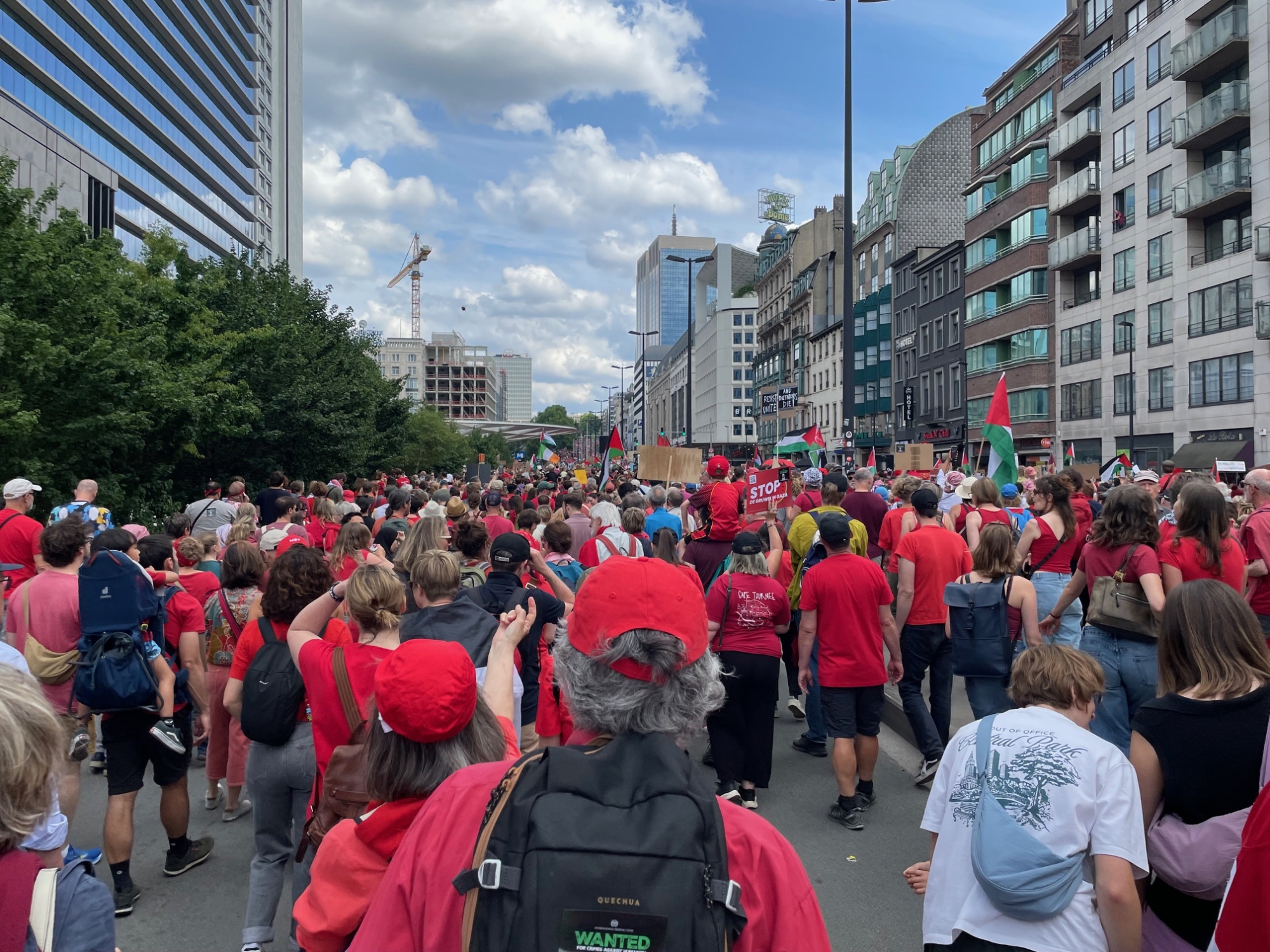
Yesterday, on June 15, people in Belgium and the Netherlands took to the streets together to draw a red line against Israeli violence in Gaza. In Brussels, more than 100,000 people gathered. In the Netherlands, people had already taken to the streets on May 18. That demonstration drew more than 100,000 people; one of the largest demonstrations of this century. And this second time, no fewer than 150,000! That means more than 250,000 people who, undoubtedly, found it hard to fall asleep that Sunday evening, June 15, still glowing from such a powerful symbol of resistance and solidarity. And more than 250,000 people, some of whom undoubtedly also woke up this Monday feeling somewhat sad and uprooted.
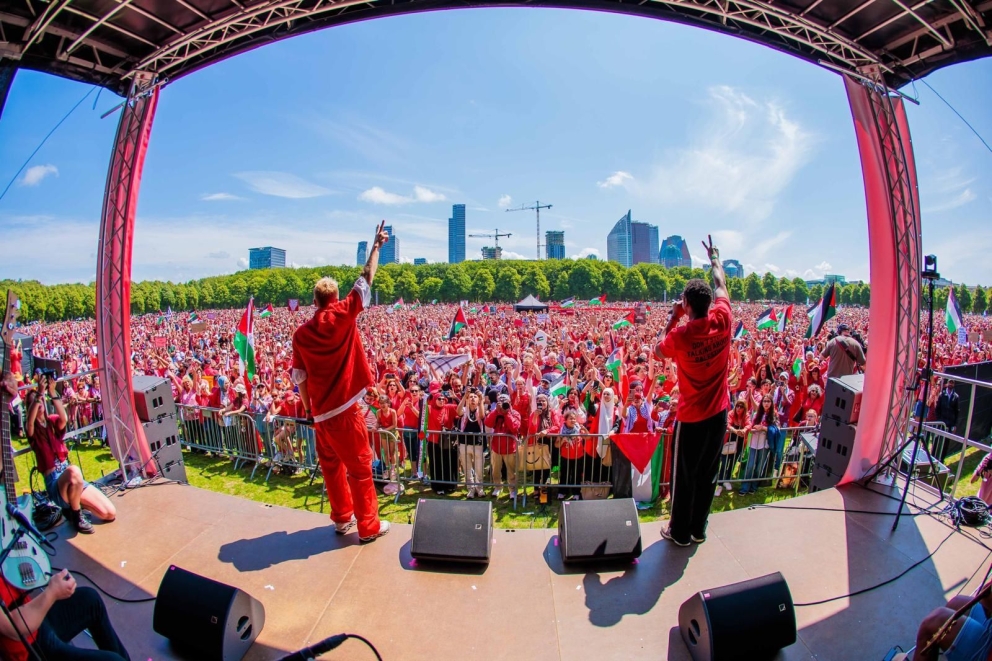
Because honesty compels me to say: the day after every demonstration I attend or organize, I actually do feel a bit hungover: you wake up and the world is still the same; Israel is still dropping bombs, there are still no affordable homes, we have once again shot past a planetary boundary, Dutch Prime Minister Schoof tweets something meaningless and Belgian minister Prévot says he will not do anything extra, because “little Belgium will not make Israel bend”. They had a drink, took a piss, and everything stayed as it was.
I think that feeling is recognizable to everyone who is active in social movements. And this phenomenon is as old as social movements themselves. There is even a term for it: the perception of failure.
As early as the 1970s and 80s, the American activist Bill Moyer described in his Movement Action Plan (MAP) how social movements go through such a phase after a peak of protest and mobilization. Activists often feel disappointed once the wave of protest subsides, while it is precisely at that moment that they could achieve important results. Moyer saw a paradox in movement building: after a period of mass action – the take-off – despair often sets in. The goals have not yet been achieved, in the eyes of some there have not yet been any ‘real’ victories, so people conclude that the movement is failing. People then drop out, burned out from all the work, while the media reinforce the image that “the movement is dead" now that only a fraction of the number of people show up at the next demonstration.
Housing protest
This is also very recognizable for, for example, the Dutch housing movement, where after the largest Housing Protest since the 1980s, each subsequent demonstration drew somewhat fewer participants and politicians mainly talked at length about frames that the movement had charmingly revived, such as ‘public housing’, but concrete results largely failed to materialize. Some people in the housing movement then dropped out, or, for example, began focusing again on direct action such as stopping evictions and squatting buildings .
Moyer's key insight: this disappointment after mass mobilization is a normal part of the process. It does not mean that we have truly failed. On the contrary, anyone who knows the history of successful movements knows the following: it is precisely movements that withstand this setback that will ultimately achieve their demands – once considered unattainable. The art is to recognize this phase for what it is and not give up, but to take a step back and prepare for the next round. After all, public awareness has increased enormously because of the demonstration – we did not reach those millions of people for nothing. So the iron is hot, and we must turn that awareness into the next step.
That brings us to a harsh reality: one or two protest marches, however massive, are rarely enough on their own to persuade policymakers. Why is that? Power – whether it is a government, policy or an unjust system – always rests on several pillars. Think of political pillars of support, economic interests, media frames, international alliances, public opinion, and so on. A protest of 100,000 people gives one such pillar (public opinion) a solid shove, but the other pillars must also start to wobble before those in power truly move.
Letting pillars crumble
At S&L, we sometimes use the framework of the Pillars of Power for this: identify the supporting pillars of a status quo, and determine where you as a movement can strategically apply pressure. A historical illustration: the tipping point in the resistance against Milošević came when the Serbian police refused to keep shooting at demonstrators. One pillar – the loyalty of the security services – gave way. That logic also works in democracies, albeit more subtly. Power is never absolute. It depends on cooperation, consent and silence.
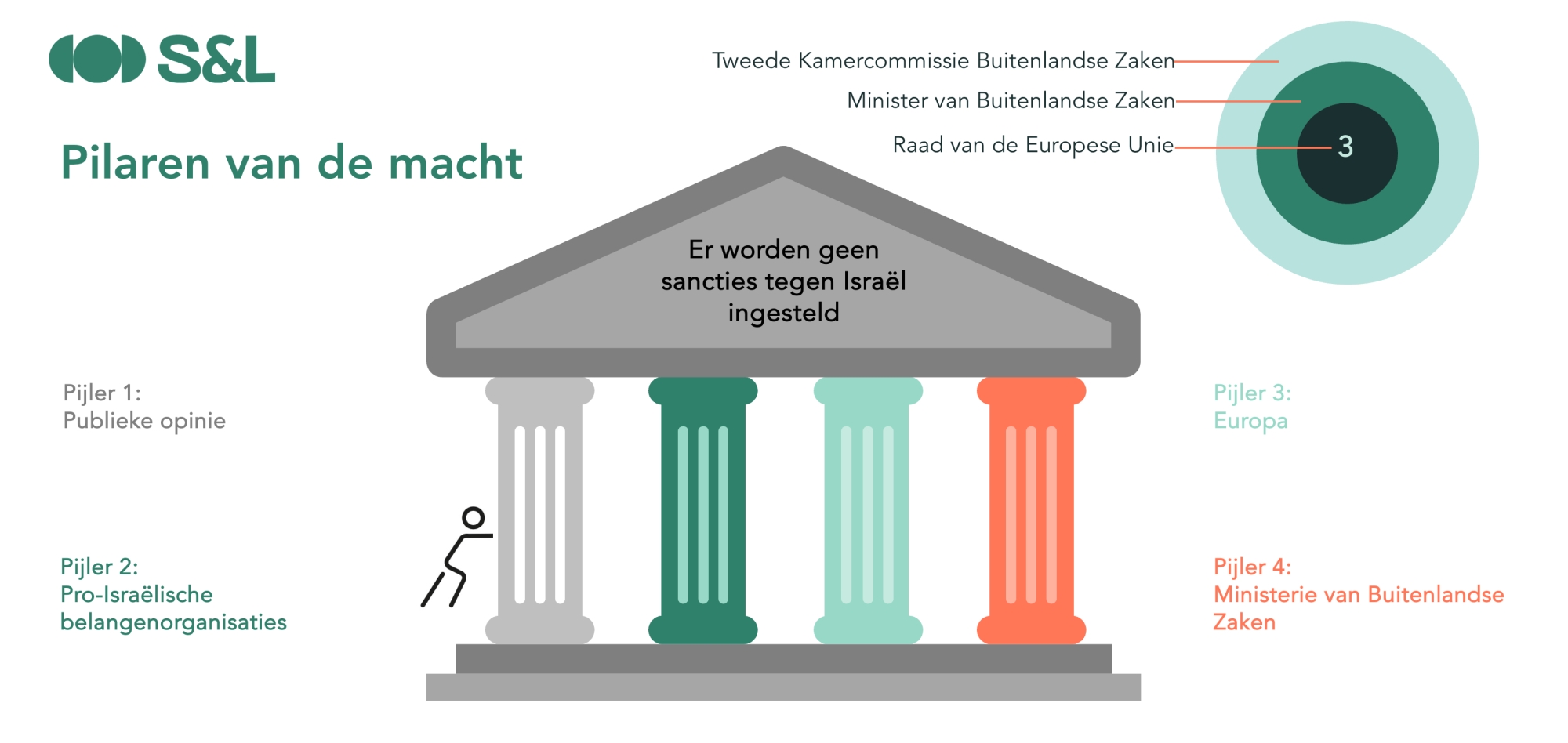
That realization makes it clear that a march is not an endpoint, but a springboard. The question is not whether protest works, but what comes after it. Which tactics are used to keep up the pressure? How do you ensure that the energy does not drain away, but is converted into political and social leverage?
Back to the red line: which supporting pillars keep the status quo standing? Is it the fear of coalition parties to break the unity of government policy, is it certain economic or geopolitical interests, is it because Israel is an important supplier of surveillance systems and weapons systems in Europe? Are there political parties that, because of Christian or social-democratic ideology, have difficulty speaking out against the state of Israel?
Our next actions as a movement can then focus on those weak spots. Eliciting statements from Members of Parliament and government officials, initiating economic boycotts or proposing alternatives, bringing to light the violation of the human rights of Christians in Palestine, showing that there has long been no Judeo-socialism left to be found in Israel, or exposing and delegitimizing economic collaborations (e.g. arms supplies and the presence of Israelis in ‘our’ sensitive espionage systems).
Above all, we must realize: the real power ultimately lies with the people themselves, with us. Those in power have nothing more than borrowed power, which we give them and can take away again.
A protest march is one expression of that power. But we have many more tools at our disposal: elections, consumer choices, strikes, petitions, legal action, international solidarity – each and every one a way to make a pillar wobble.
A diversity of tactics
The fact that a single protest on its own is not enough does not mean that protest is therefore pointless. It does mean that we must scale up and innovate in our approach. Micah White, co-founder of Occupy Wall Street, describes it quite sharply in his book “The End of Protest (2016)”: "Activism is broken. We have seen the largest protests ever, yet these mass mobilizations no longer change society." According to him, protest has reached a crossroads: innovate or become irrelevant.
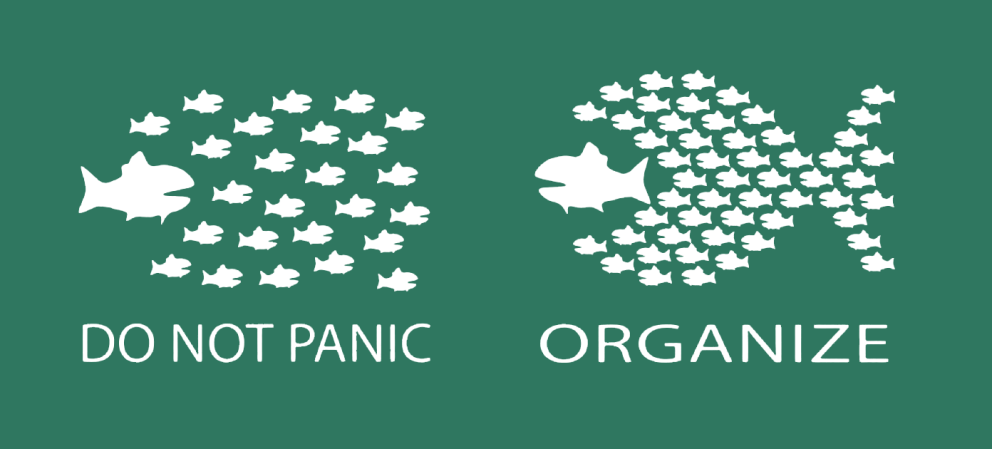
“Don’t panic, organize!”
Toppling a dictator with rice pudding
So, how do you innovate? That’s where strategy comes in. We need to turn the energy and attention of movements into a diversity of tactics. One of the best-known members of the Serbian movement Otpor!, activist and strategist Srđa Popović, gives us in Blueprint for Revolution (read an entertaining anthology by colleague David De Beukelaer here) a number of tips we can learn from:
- Start with small victories: After such a huge protest, it is tempting to immediately demand the maximum, but it is smarter to set achievable, concrete goals. That keeps people motivated and shows that the movement can truly achieve something. Perhaps that means forcing a parliamentary debate or persuading a company to cancel a contract. Every tangible win, however small, keeps the fire burning and builds (self-)confidence within the movement.
- Maintain a broad coalition: The strength of May 18 and June 15 was that we were so diverse and yet united. More than 50 organizations were involved in organizing the demonstration. We must cherish that broad alliance. Popović emphasizes that successful revolutions unite people around a shared goal, producing a colorful coalition. Focus on what connects you and keep internal divisions internal. That also means: keep talking to different groups, from human rights organizations to faith communities and trade unions.
- Creative, disruptive action: the demonstrations were disruptive and creative; we must continue down that path. These kinds of peaceful, disruptive movements attract more diverse support, are impossible to ignore, but at the same time make it harder for authorities to suppress the protest with violence. In addition, creativity challenges power. Having everyone wear red clothes is such a creative choice. We cannot mobilize 100,000 people every week, but we can come up with creative actions that get media attention and increase the pressure – think symbolic stunts, sit-ins, boycott actions or viral campaigns. We live in an era in which a smart online action can have just as much impact as a march in the streets. A successful movement runs a marathon in relay form.
- Stay agile and keep learning: A movement must be able to adapt to new circumstances. Suppose the political landscape shifts or a new crisis arises: respond to it. We must not fall into a fixed routine. Try different tactics, evaluate what has an effect and what does not. Learn from every action – from successes as well as failures. This learning culture keeps the movement sharp and effective (and prevents radical rigidity).
- Think ahead: Finally, think about the long term. What if our demand is granted after all? Are we ready for the next phase? Popović warns that a victory is only step one in a larger process. Suppose the cabinet ultimately gives in and goes further than drawing a line in the sand: how do we ensure that this change is sustainable? Do we then have follow-up ready (e.g. pressure on compliance, international follow-up campaigns, etc.)? By thinking ahead, we prevent the movement from fizzling out after a single change of course.
I also have to give a small compliment: these red line protests are extremely strategically organized: anyone who looks at the website of the Dutch parliament will see that a debate on Israel policy is on the agenda in the week following the protest. And the week after that, all European leaders will be at an important European summit where this issue is also on the agenda. The Flemish NGO 11.11.11 called on the Belgian government to now implement previously announced measures against Israel. So this is the perfect moment to exert pressure through a protest. The more than 200 organizations that organized both protests saw that too.
Strategy is the engine
Greenpeace International strategist Amrekha Sharma once taught me: “anger is the spark that starts the engine, but hope is the fuel that keeps it running.” Anger, then, is the spark that drives millions of people around the world into the streets; hope is what keeps the movement alive. And strategy is the engine for every change.
So while it is not strange if you feel a protest hangover this week, the last thing you should do is sit back in despair. On the contrary: this is the moment for the movement to mature. We are at a tipping point, we have the attention, we are getting the numbers. This is the moment to act strategically and follow through.
We do that by turning the energy into action: continuing to exert pressure on all fronts, informing and involving your supporters, seeking new allies and using creative forms of protest and influence.
Every major movement in history has known moments of setback, doubt and defeat. Again, activism is not a sprint, but a marathon in relay form. To whom or what will you pass the baton next?










