Since 2020, civil society has unfortunately had to deal with substantial budget cuts. Subsidies are being reduced (sometimes radically), funds are disappearing or reprioritizing, and costs continue to rise.
These are jobs and assignments being lost, sometimes personal tragedies. These are sometimes organizational missions that will never be realized. These are a great many people under stress. With sadness and anger. It means saying goodbye to too many good people.
And then they call me and my colleagues at S&L. Help.
Of course, we cannot work miracles. But often we can help. We do that because we are on your side: that of civil society and the people striving for positive social change.
Part of our support (the most important part) then lies in making your funding mix healthier, optimizing your private fundraising, coming up with other revenue models, or increasing the efficiency of your organization’s operations, but with these kinds of sudden budget cuts you often cannot avoid a restructuring or reorganization either, and sometimes one in which jobs also disappear.
Damn it.
Least favorite task
At S&L, this may well be one of my least favorite tasks: guiding an organization through such a period. We often work in two phases. First, we help think through scenarios, when it is not yet clear how far-reaching the intervention needs to be. Then we support the implementation. And yes, that is partly a technical and organizational intervention. But just as much a human task, and often with an important communication challenge.
Recently, I gave a workshop to a group of directors of large development organizations about that communication aspect. I am happy to share the lessons from that session with you completely free of charge, because good communication can alleviate a great deal of human suffering.
Information is necessary, but not sufficient
There is a difference between information and communication, between informing and communicating. Information is the distribution of information; communication is breaking through with information, reaching people and influencing their thinking or behavior.
One of the more frequently heard frustrated comments from teams and stakeholders in these kinds of processes is therefore: “I understand that it was available to read (on the intraweb/in the newsletter/at the all-hands), but in any case it was not clear to me, I had not seen it.”
So the question is: how do you break through? How do you build support? What is the role of communication in change management? Successful communication takes the recipient into account. How they understand your information, how they weigh it, and what that does to their actions. In a restructuring, employees, volunteers, supervisors and partners pay attention not only to the message, but also to the timing, consistency and sender. Who is saying this, why is she saying this now, and what does this mean for me?
And note: not communicating is also communicating. Silence is almost always read as uncertainty, inability or disinterest. The starting point is therefore not collecting or distributing an ever-growing amount of information, but creating meaning. A story that explains why this moment has arrived, what is changing, what remains, what that means concretely for each group, and when you will be in touch again.
Communication requires design
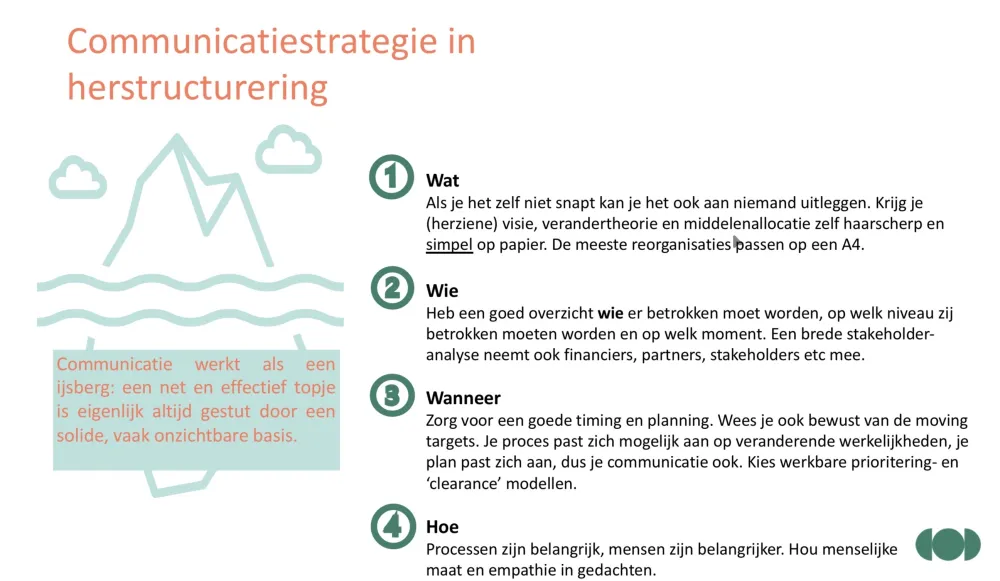
Good communication in a reorganization does not consist of a single email or a Q&A document. You need a coherent (internal) communication strategy. In practice, I think that comes down to three choices:
First: formulate one core story. In one short paragraph, it must be clear why this is necessary, what is changing, what remains standing and what the very next step is. That core story forms the basis for everything that follows. You can develop it into a concise message house (per target group) or visual discussion sheet, but your story should really also be easy to tell without any tools. Almost every reorganization fits, if you think about it carefully, into a text on one A4 page.
Second: determine the order. Who hears what, and when. Internal target groups hear this first, or at least no later than external parties. Internally, dialogue often works better than broadcasting: a meeting, a post on the intraweb with room for questions. Externally, you opt for more control, for example via a letter to donors or an agreed line for spokespersons. For the phasing, you have helpful tools, such as the participation ladder (RACIO) or a good stakeholder analysis. These untangle a complex field of people who all have a role, and that field is often full of catch-22s. Put it all in order.
Third: agree on a rhythm and way of working. Define how often you communicate, for example weekly, even if there is little news. Make clear who drafts messages, who reviews them and who makes the formal decision. And agree on what you do when information changes. That prevents noise, contradictory messages and unwanted leaks. In a fuzzy and blurry time, in which your own information position and knowledge are also constantly changing, it can help to work with a traffic-light system and give decisions or information a color (red = uncertain and confidential, yellow = evolving and still sensitive and green = final and (semi-)public).
All of this is never separate from the organizational structure and, more importantly, the organizational culture. Processes are important, but behavior and mutual relationships determine how messages land. What is visible, the email, the presentation, the meeting, rests on an invisible foundation of agreements, trust and exemplary behavior. Culture eats strategy for breakfast is true here as well.
What you encounter along the way and how to steer it
Rumors arise faster than you think.
If communication comes too late or is fragmented, people fill in the gaps themselves. That speculation and gossip is human behavior. You can limit this by communicating early, sticking to the facts and always announcing a next moment. A simple timeline, ladder and traffic light also help here: who hears what, at what moment.
Transparency only works with clear boundaries.
Say what you know and do not conceal it, but also do not share everything that is still uncertain. Make an explicit distinction between what is established, what is still in development and what remains confidential. For the latter, briefly explain why. Internally, it helps to use fixed language for this, so it is clear what you are doing.
Come on, read the room.
Changes always trigger predictable reactions: a sense of loss, uncertainty, questions about fairness. People are deeply engaged with your organization; some may have been working there much longer than you have. That kind of involvement is a considerable strength, but in change processes it can also be a very inhibiting factor. At the same time, you cannot manage emotion away; empathy is perhaps the most important part of this process and also the hardest to explain.
There is no handy matrix or attractive framework for empathy. Still, a few tips: immerse yourself in social safety (if you have not already done so). Take your recipients into account in your use of language. Name what is certain, indicate where people have influence, prevent us-versus-them thinking and briefly explain on the basis of which criteria decisions are made. That increases calm, accelerates acceptance and shows that you have thought about a fair way to set up such a process.
Your external legitimacy also requires attention.
Donors and partners who hear indirectly what is going on lose trust more quickly. Therefore, make an overview of your most important stakeholders in advance and determine what you promise each group: inform, consult or actively involve. Choose the order and the channel before you communicate.
Without a mission, you lose direction.
If budget cuts become disconnected from the mission and impact story, the feeling quickly arises that everything is about money. By sharpening your Problem Tree and Theory of Change again, you can show what remains, what changes and why. That helps both internally and externally to stay on course. Finding it difficult? My colleague Koenraad has created a great e-book to help you get started with this.
Participation requires clarity about decision-making.
Involving people is valuable, but not every decision is made jointly. Therefore, make visible who is responsible for what, who contributes ideas and who is informed. Link that explicitly to your participation promise. That prevents token consultation and paralysis.
One story, internally first.
Nothing undermines trust as quickly as employees hearing their own news from the newspaper or through partners. Work with a clear information sequence: first supervision and management, then employees, then key partners and donors, and only then the public and media.
Getting started practically
So, in summary:
1. Make sure you have a plan, including phasing
2. Use a participation ladder and implement a “clearance” method such as a traffic-light model
3. Seek out dialogue.
Do not wait until everything has crystallized. Write your core story in five sentences today. Record when you will give the next update, who will be informed internally first and who formally approves the communication.
Provide one internal place where all current information comes together, for example an FAQ that you update after each update. Refer back to it consistently.
Keep measurement simple. Check whether people have been reached, whether they have understood the message and how it was received. Use that to sharpen your next communication.
And do not forget the human side. Structure creates order, but tone makes the difference. Show up yourself at the important moments. Name what is disappearing, be honest about dilemmas and make visible what you consciously choose. Often, a reorganization is also a way to create focus and increase your impact per euro; tell that story too.
Finally
Good communication is like an iceberg: a clearly visible tip is supported by a solid, often invisible foundation. Much of the literature and management books about communication in reorganizations mainly focus on how, as an executive, you should tell an inspiring change story, show that the reorganization primarily offers opportunities, and provide a new direction. And yes, inspiring people is important too. But in my view, being clear and justified in your actions is more important. I’m curious how you see this. Are these tips too practical and simplistic for a process that is inherently complex? Should something else be at the center? Let me know; send me an email.