What if your structural subsidy disappears? The question has been buzzing around various sectors for some time, but is becoming more urgent by the day. What if your operating resources dry up, while your operations and responsibilities continue to grow? In the non-profit, social-profit and NGO sectors, financial dependence on governments is still the norm. But what if that norm shifts?
Some organizations respond with hopeful waiting. Others switch to survival mode. But more and more organizations are realizing: it is time to fundamentally rethink rather than hope. That realization also raises new questions: which funding mix is desirable? Which strategic reflexes should you develop before it gets to that point? And where do you stand today - really?

Some organizations believe they are more independent by not accepting subsidies, but no source of income is truly free from expectations. Donors ask for impact reports, clients expect service, sponsors want visibility. Instead of striving for ‘pure’ autonomy, it is more realistic to work on healthy interdependence: for example, a mix of 30 - 50% subsidies, 30% earned income, and 30 - 40% from funds, donations, or shared projects. That balance leaves room for both stability and agility. (Watch our webinar on a healthy funding mix)
Three scenarios you need to explore today
Anyone who wants to become robust needs to think ahead in scenarios. Not because they will all happen tomorrow, but because you need to dare to calculate them today. At S&L, we distinguish three realistic situations that organizations are confronted with when structural funding comes under pressure.
(And psst ... there is also a fourth, deceptively quiet scenario that is rarely perceived as urgent – but is at least as important.)
Scenario 1 – Partial structural contraction
In this scenario, your operating subsidy decreases by 30 to 50 percent. The organization remains formally afloat, but the impact is noticeable: programs are shortened, support functions disappear, and workload increases. In practice, many organizations then try to salvage what can be salvaged, with small savings or ‘doing more with less’, without really choosing a direction.
But anyone who shrinks without rethinking weakens structurally. The challenge lies not only in cutting back, but in making strategic choices: what contributes to your mission? What has grown historically but is no longer sustainable? Which processes can be simplified, and where is collaboration with other organizations a better option than internal downsizing?
Scenario 2 – Total loss of structural support
Here, structural funding stops completely. Operations in their current form are no longer feasible. Many organizations respond with panic decisions, abruptly discontinuing activities or attempting a rapid commercial reorientation. But those who think too late lose all room for maneuver.
This scenario requires a fundamental reset. Not everything has to disappear, but everything must be questioned again: your mission, your scale, your revenue model. Can you relaunch in a different form? Through embedding in a network or umbrella organization? With a greatly simplified structure and a sharper focus? What you need then is not a plaster on the wound, but a redesign of your reason for existence, with clear choices and shared leadership.
Scenario 3 – Fragmentation through temporary project funding
In this scenario, structural resources disappear, but you continue to have access to temporary, project-based, or thematic subsidies. At first glance, the organization seems dynamic – many ongoing projects, active planning – but lacks direction. The core structure has been hollowed out, and everything revolves around deadlines, accountability, and short cycles.
Here, a silent exhaustion threatens: teams lose oversight, policy thinking disappears, and project logic takes over from long-term impact. In this context, it is crucial to maintain a strong substantive compass. This means that, as an organization, you consciously select which projects contribute to your mission and which tend to distract from it. You also need a connecting structure that provides direction, maintains oversight, and ensures that project-based work does not become a substitute for strategy.
Scenario 4 – The hammock
There is no scarcity, no crisis, no urgent policy change. Your operating subsidies remain stable, your annual rhythm stays intact, and your core team remains largely unaffected. So everything seems fine. But precisely that apparent calm is an underestimated risk: you end up in a dormant state. You become dependent on a funding model that is not guaranteed to last, while your internal operations remain based on assumptions from the past.
In this situation, strategic complacency threatens. The urgency to make fundamental choices, tackle inefficiencies, or explore new avenues is absent. Internal processes become outdated, innovations fail to materialize, and there emerges a culture in which management is mainly occupied with ‘preserving what exists’, instead of ‘building what comes next’. When the context does shift - in policy, financially, or socially - your organization is more vulnerable than you thought.
The relationship with employees and partners also changes subtly but significantly in this scenario. Stable resources can lead to predictability, but also to declining alertness and creativity. New employees feel less room to contribute ideas, long-standing routines are rarely reviewed, and even when successful, the underlying question remains: is this the best we can do with the resources we have?
Detection is crucial. Various warning signs can point to structural risks years in advance: policy priorities shift, funding logic changes, evaluations or audits contain critical signals. Organizations that are alert to these signals retain strategic time to adapt – before they have to.
“The biggest mistake? Waiting until it’s too late. What you do today determines whether you can still choose tomorrow.”
What do you do before it gets to that point?
The biggest mistake? Waiting until it is too late. What you do today determines whether you can still choose tomorrow.
- Carry out a stress test periodically How agile is your organization if something changes tomorrow? How heavily do you rely on one funding body, one policy period or one substantive theme? Simulate the other three scenarios. Use your relative calm to do the thinking that others only do under pressure.
- Map out your complete financial structure Not only your income, but also your cost drivers, fixed costs, recurring weak spots and dependencies. A financial audit (scan) reveals where buffers are lacking, where waste is simmering, and where you are vulnerable to external decisions.
- Analyze your activities and their impact per euro Which activities are mission-critical and future-proof? Which cost a lot but deliver little social value? This requires courage. But also: focus.
- Develop a scenario analysis What if your budget drops by -20% tomorrow? Or -50%? Which roles will be cut? Which partnerships become crucial? What remains standing, and why? Name it, calculate it, discuss it.
- Build in diversification now Do not wait for shortages. Start today with alternative revenue streams: social business models, services to third parties, membership fees, fundraising, partnerships. Not as a replacement for subsidies, but as a buffer against dependency.
Crisis on the horizon?
Is scarcity coming? Then clarity matters above all. Set priorities. Make it visible internally: what will we still do? What will we no longer do? And why? Those choices require courage - but also leadership. A fragmented organization loses energy and direction. A team that knows what it needs to focus on maintains cohesion.
- Share your financial reality. Transparency is not a risk, but a lever. Teams may know how things stand, even when it is difficult. Honesty creates trust, engagement and ownership. Those who feel acknowledged are willing to help look for solutions.
- Strengthen partnerships. Not only substantively, but also in terms of back office, data, logistics or staff sharing. Share burdens, gain flexibility. Organizations that work together can scale better - up and down - without losing sight of their mission.
- Reassess your cost structure. Not every expense can be embedded. Some costs have grown historically, but are no longer sustainable. Look for flexibility: what can be temporarily reduced, rescaled or shared? See which systems can be simplified.
- Review governance and leadership. In times of crisis, clear roles, short lines of communication and transparent communication are crucial. This requires a tightly aligned leadership team that can act quickly, communicate clearly, and at the same time leave room for consultation and feedback. Not hierarchy for hierarchy’s sake, but decisive action with empathy.

What next?
After the storm, it is tempting to return to the way things were. But those who do not learn, repeat. Use the calm to evaluate what held up, and why. Record which processes, partnerships and choices provided resilience.
Also document your lessons. What worked well? What should have happened faster? Who took initiative? Which mistakes were avoided? Turn this into knowledge that is both shared and embedded.
Formulate new principles. Include scenario thinking in your strategic cycle. Let your annual budget be preceded by a critical review. And keep alternative paths open, even when the pressure eases. Anticipation becomes a culture, no longer just a reflex.
When do organizations reach out to partners?
Collaboration is rarely the first reflex. Usually, it only emerges when there is no stretch left: when internal buffers are becoming exhausted, or the strategic horizon narrows. But those who wait that long give up a lot – room to negotiate, trust within the team, and the time to build something solid.
The decision to collaborate often takes place on two levels at once. On the one hand, there is the functional logic: can you share costs, deploy people more intelligently, combine systems, or organize your back office more efficiently? On the other hand, the strategic added value matters: can you stand stronger together in conversations with governments, fundraisers or the broader social field?
Differences in pace, scale or structure do not have to be a breaking point - provided you make explicit what you share, and what you deliberately keep separate. Good partnerships are not built on equality, but on clarity. The earlier you start that exploration, the greater the chance that it will yield something before it truly has to.
Ten pitfalls on the road to financial alertness
- Invisible vulnerability: the financial structure has never been fully mapped, so you do not know your real risks.
- Lack of mission-driven direction: activities are not evaluated based on social return per euro.
- Projects without a backbone: the organization stacks project funding without a connecting, supporting whole.
- Internal silence about finances: employees know too little about the financial situation to take ownership.
- Politically naive: strategy relies on the favor or continuity of a single policy period or person.
- Missed opportunities: alternative revenue streams are unknown, unused or untapped.
- Absent scenario analysis: calculations are only made once there is a crisis, not before.
- Sluggish decision-making: choices require so much time and consultation that flexibility is lost.
- Rigid cost structure: fixed costs and procedures leave little room for agility.
- Too little shared leadership: the team is insufficiently involved in decisions or transitions.
Building rather than bluffing
Financial sustainability without subsidies is not a pipe dream or an ideological choice. It is a strategic exercise, already necessary today in many sectors – and soon inevitable in even more. Those who wait until the time comes will be too late. Those who start building today – on insight, partnership and alternative models – will not have to bluff tomorrow. They will be able to choose.
Request your financial scan today
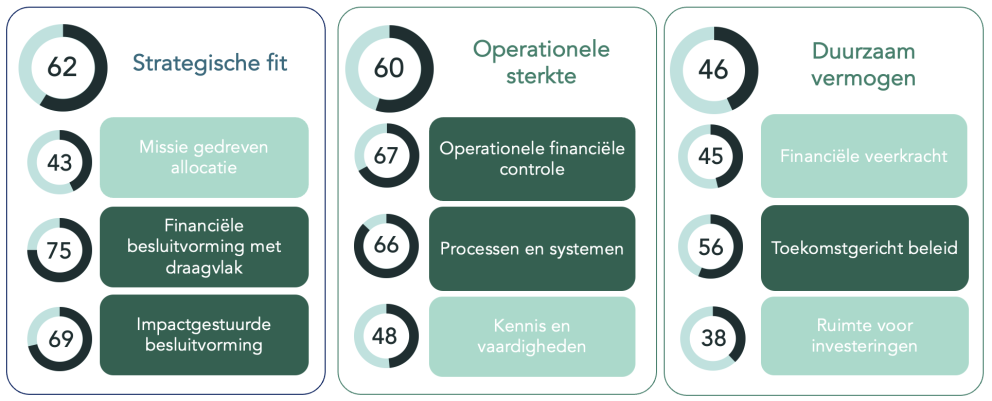
The Financial Health Index from S&L provides your organization with a clear, in-depth assessment of your organization’s financial health.
Based on key indicators such as profitability, liquidity, solvency and operational efficiency we map out both strengths and points for attention. This makes it possible to make targeted strategic choices and make timely adjustments. Read more or get in touch.
More information about the financial scan from Nicholas Vijverman and Joos Callens. For questions about your financing mix, you can contact Stijn Demuynck.










