“The old world is dying, and the new cannot be born “
It seems like a perfect summary of the times we live in.
Struck a chord
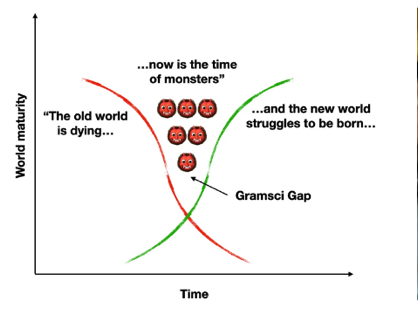
The chart went viral. It touches on something many people recognize: the feeling that we are living through a period of transition. Between an old world that is dying and a new world that still has to take shape. In that in-between space, chaos arises – and monsters.
The chart was created by Venkatesh Rao, an American consultant, and gained extra attention through the German futurist Thomas Klaffke and NRC journalist Wouter Van Noort. That is how, within a few days, it ended up in our Flemish bubble.
In less than a week, it went around the world. Viral, you might say. That means it struck a chord.
© Chart: Venkatesh Rao
Fact-checking
Colleague Fredo did take a moment to fact-check it. The original quote reads as follows:
“The crisis consists precisely in the fact that the old is dying and the new cannot be born; in this interregnum a great variety of morbid symptoms appear.”
Why is this nuance important? In times of transition, it is crucial to know which information you can trust. Gramsci’s work was also about cultural control and hegemony – how powerful groups exert influence on society. For example, by controlling the narrative about society.
Where do we know that from?
Losing or retaining control?
The addition “Now is the time of monsters” does not come from him, but from Slavoj Žižek, another contemporary philosopher. Still, this interpretation has an enormous impact, because it precisely captures the tension of this time.
The “monsters” symbolize the tensions and unexpected excesses that arise when old systems collide with new ideas. They are embodied by oligarchic figures such as Musk and Trump.
For me, the key question here is: are these phenomena the death throes of an old system that is losing control? Or are they actually a strategy by those in power to retain that control? Or in the words of Nate Hagens, a well-known podcaster and systems thinker: “Is it gonna break or bend?”
Discussing these questions with your colleagues often stirs up a lot. It also reveals underlying drivers and assumptions that we bring to the workplace. It is important to be able to name these clearly.
At S&L, we use our own interpretation of Gramsci’s words: “The old is dying, and the new cannot be born. With the right help, the new world becomes radically better.” You can probably guess how we look at the situation. Developing strategies and supporting leadership for a better world. Yes, we can.
What can we do?
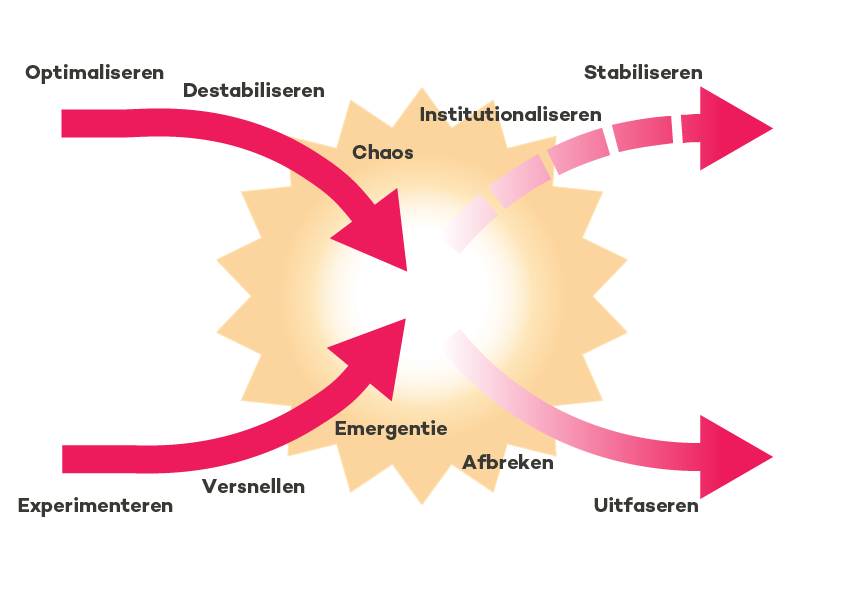
The question as an entrepreneur or manager is, of course: what can we do? How should we act in this chaotic period? This is where the X-curve of transition, developed by Jan Rotmans, comes in handy. The same analysis, but worked out differently. The model shows what happens when old and new worlds collide.
The X-curve helps you think about four strategies:
- Transforming: Which elements of the old system can you improve?
- Building up: How can you make the new world stronger?
- Building on: What remains valuable and can you preserve?
- Phasing out: What needs to disappear to make room for renewal?
In workshops, we use this model to help organizations determine where they stand in this transition. It is essential to know which strategy fits your situation.
© Dutch Rsearch Institute for Transitions
Living between two worlds
When I look around, I see how many impact entrepreneurs find themselves in a split position. They often have a vision rooted in a new world, based on values such as sustainability, inclusivity, and social justice. But at the same time, they operate in the old world, where endless growth and extraction are still dominant.
This tension calls for a different form of leadership. How do you remain true to your values while operating in two worlds?
Futures thinking as a tool
An effective way to keep your footing in a time of change is by embracing futures thinking. This means consciously creating space and time to imagine a new, radically better world. In our future-oriented programs, we always start by loosening up our thinking and exploring possible futures. This process helps us break free from entrenched patterns and traditional thinking.
Scenario analysis is also a valuable method. With it, you explore multiple scenarios and place them side by side. It provides insight into possible developments and helps you determine which direction you can and want to take with your company. This gives you a grip on uncertainty and enables you to make conscious choices for the future.
In essence, it helps you focus on system change instead of fighting symptoms.
'But it’s already so busy now’
During a workshop, I heard someone say once again: “But it’s already so busy now, Fredo.” By that, they meant that they have no time or experience with long-term thinking. But let me reassure you: long-term thinking does not have to be complicated or time-consuming. With a few simple and enjoyable exercises, you can effortlessly integrate this into your organization.
And it is not only about long-term thinking, but also about long-term feeling. What do you want to leave behind for the generations that come after us? This sense of personal legacy is often the driving force behind a real willingness to act.
Moreover, you can see signals of the future in the present. Ghent, for example, is buzzing with innovative ideas and companies that put impact at the center. And I am not talking about the tech or AI sector, but about entrepreneurs who do not see impact as a “nice-to-have,” but as the foundation of what they do.
As the X-curve shows: the future often starts small, with ideas that emerge almost unnoticed. It is up to us to notice and support these emerging developments. A start-up mentality, yes, also in social or non-profit companies.
Creating the future?
Feel like exploring, discussing, or imagining the future?
- Is your organization part of the old story, or are you helping build a new world?
- In what way do you include the future in your decisions ?
- How are you already steering your company as a good ancestor?
Send an email to Fredo, our impact DJ and resident futures thinker.
Everything starts with an open conversation.
With the right help, the new world becomes radically better...