At many organizations, financial stress was palpable over the past year. This was not only due to a subsidy that turned out less favorably or a year-end campaign that disappointed. The real cause often lay in the tight results of recent years and a challenging budget for 2024. Familiar factors such as rising labor costs due to indexations and high inflation accelerated the cost side. Unfortunately, revenues did not rise (quickly) enough to keep pace.
In 2025, too, the financial puzzle remains complex for many organizations. This makes it worthwhile to take another close look at the revenue model and examine whether sustainable adjustments are needed.
Why take a closer look at your revenue model
For both for-profit and non-profit organizations, the rule is that at least as much money must come in as goes out. Or in other words: without sufficient financial resources, even the noblest missions cannot be pursued. A strong revenue model helps create financial stability.
A revenue model is the collection of all the ways in which an organization or company generates income to make its activities possible. There are many possibilities for this. Traditionally, this involves looking at subsidies, fundraising or philanthropy, but although these are familiar and established channels, there is also a risk of dependence on possible political or economic whims among governments and donors.
More and more organizations are therefore also looking beyond the boundaries of traditional channels and drawing inspiration from other models. Think, for example, of selling goods or services, subscriptions, rental, ticketing, upselling … It often turns out that the logic is not necessarily different and is complementary to existing channels.
Which revenue model fits my organization?
Finding a logical and sustainable revenue model is one thing. A model that strengthens your organization is one that not only generates financial resources, but also aligns seamlessly with the organization’s mission and values.
Important aspects in this are:
- Authenticity: a model that embodies your mission radiates authenticity, ensures a better match and increases the trust of stakeholders and financiers
- Synergy: a suitable revenue model creates synergy between financial channels and tracks and your mission. As a result, financial resources not only support the organization, but also strengthen your mission.
- Long-term impact: A well-thought-out revenue model focuses not only on the short term, but also ensures that your organization can continue to make an impact. Even in changing financial circumstances.
To take the right steps in this, you start from the impact your organization wants to make. A useful tool for this is ‘impact strategy’. By building your strategy from the long-term change you want to create and linking your revenue model to it, your financial puzzle strengthens your mission and you remain true to your values. You will also immediately move much faster in linking costs to revenue tracks and present yourself authentically to your future financier.
How do you build a sustainable revenue model?
A logical theory does not make practice any easier. As a director or board member, you often have to make ad hoc and pragmatic choices to cover the costs at the end of the month. As a result, the revenue model of many organizations is often a combination of different sources that are not always equally efficient, logical or sustainable. Think of the many smaller project subsidies, a hastily assembled fundraising campaign or an event at the end of the year that hopefully brings in some more money.
To arrive at a sustainable revenue model and enable your organization to play to its strengths, it is worth going back to the start and asking the question:
“What do I, as an organization, want to change in society and what are the services, activities or products I can offer for this that fit my organization.”
Although this starting point may sound simple, it is a solid basis on which to build the next steps. What do I need for this? What costs does this entail? And are these structural or specifically tied to something? Who is the end user of my services, products or activities? And who wants to or can pay for them? And what, then, is a fair price?
Once you have mapped out the different elements, you can start building. I often work with the diagram below for this. Just as important as the final figures themselves is the logic behind them. Is it correct that these revenue channels match these costs? And how feasible and sustainable is the relationship?
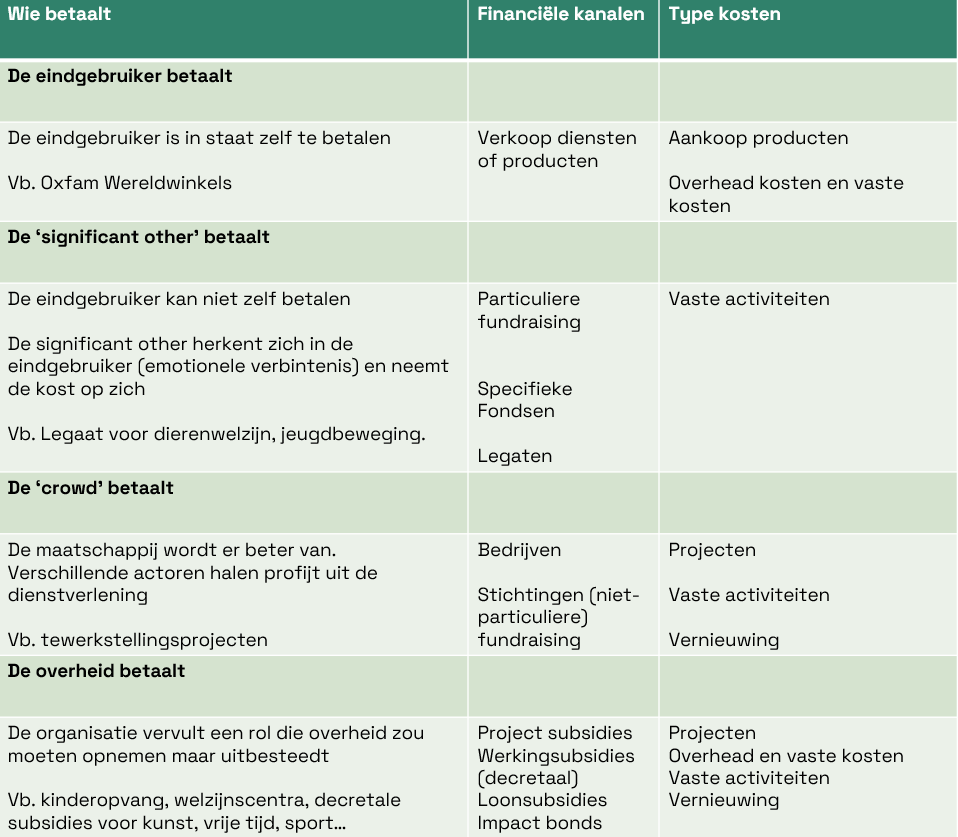
The above sounds good, but it is not always easy to reshape your revenue model based on history and existing ways of working. That is precisely what we find fascinating: taking a critical look with your organization at where the current revenue model already aligns with achieving your mission, where we need to cut and build further, and what the organization needs in order to implement this.
Feel like getting started? Then contact me via stijn.demuynck@s-l-impact.com or feel free to call me on +32 496 17 00 44. Or register for my webinar 'Time to mix it up - clarity about your funding mix' on 22 November.










