Coalitions are one of the most powerful ways to achieve a major societal goal. They connect organizations, networks, and people around a shared ambition. Yet many of those involved experience a coalition as complex. That is why the question increasingly arises of how to set up a clear strategy for an existing or new coalition.
Our experience from dozens of processes: a coalition strategy requires a different overall approach than a classic strategy process with a single organization. In a coalition, many more perspectives, interests, and working styles are at the table. Without clear agreements, an abundance of ideas quickly emerges, without a common line.
Coalitions work differently from organizations
A coalition differs fundamentally from an organization. The formal structure often remains light, leadership emerges informally, roles are not fixed, and information circulates in a fragmented way. In such a context, collaboration requires extra attention and care.
The biggest hurdle usually lies in implementing the chosen direction. Who has the time and mandate to put the strategy into practice? What resources are available? How do agreements within the coalition relate to the strategy and planning of the participating organizations?
When management teams only join later, or when partners differ greatly in scale, organizational culture, and pace, tension increases. In the background, differing views play a role about change and about the way to organize it. Conversations about the “right path” to impact influence relationships and trust.
At the same time, the potential remains great. A well-functioning coalition strengthens the narrative around a societal issue, builds a broad front, and creates a force for action that individual organizations rarely achieve on their own.
“The biggest hurdle usually lies in implementing the chosen direction.”
Typical starting situations
In our practice, we generally see two starting situations.
1. The vibrant coalition
Some coalitions are at the beginning or are making a fresh start. Energy is high, people want to get to know one another and find their place in the group. The forming phase is clearly palpable: enthusiasm and initiative arise spontaneously, while direction and structure are still being developed. Our role is to introduce rhythm, harness energy, and focus the conversation on concrete results.
2. The tired coalition
Other coalitions experience fatigue. Uncertainty about roles and expectations has triggered conflicts. Struggles over leadership have weakened relationships. Different styles or strategies have come to stand in opposition to one another. The tendency to judge one another’s approach grows, while mutual reinforcement fades from view. In these kinds of coalitions, the guidance focuses on restoring trust and creating new breathing space for the whole.
In both situations, the quality of the relationships is the core condition for any strategic exercise.
Tension from under the carpet
A strong coalition strategy grows out of mutual connection. Choices gain meaning when people get to know and appreciate one another as individuals and as organizations. Strategy takes shape within a social fabric and is carried by trust.
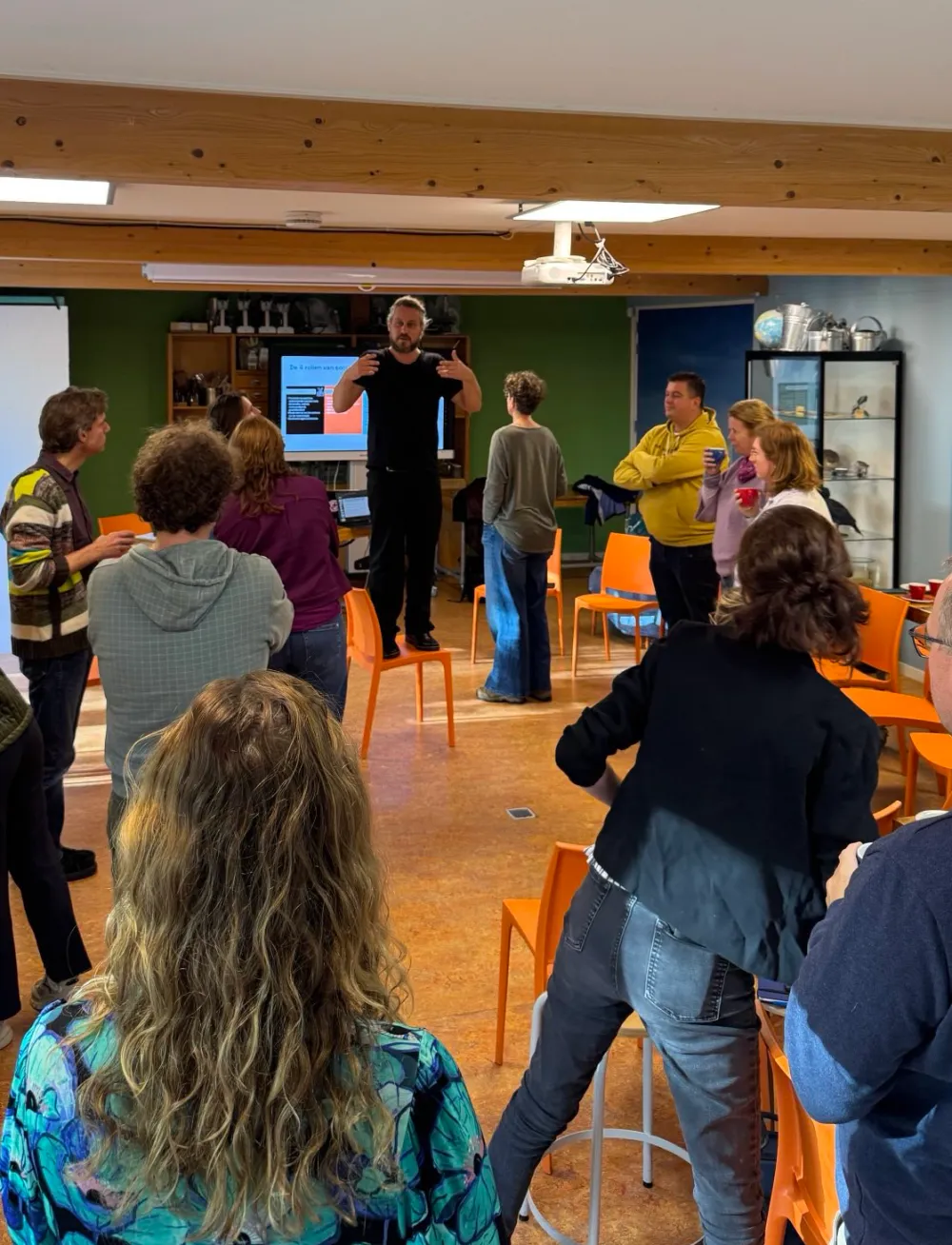
That is why we create moments in which participants show something of themselves that rarely comes up in a traditional meeting: small, authentic glimpses into motivations, boundaries, and expectations. That openness makes it possible later to cut through difficult knots.
Strong tensions call for an explicit step: we name the elephant in the room. By acknowledging the conflict, space opens up for a new conversation. If the tension remains swept under the carpet, the coalition continues to build on a shaky foundation and an agreement can easily fall apart at the first test.
The strategy day: so much more than one intense moment
In practice, coalitions rarely set aside much time for strategy. Often it is one day, sometimes even half a day. In the Netherlands this is called a “heidag”; in Belgium there is no fixed name for it. That limited time window is understandable: agendas are already full. At the same time, developing a complete strategy in one day is an ambitious task.
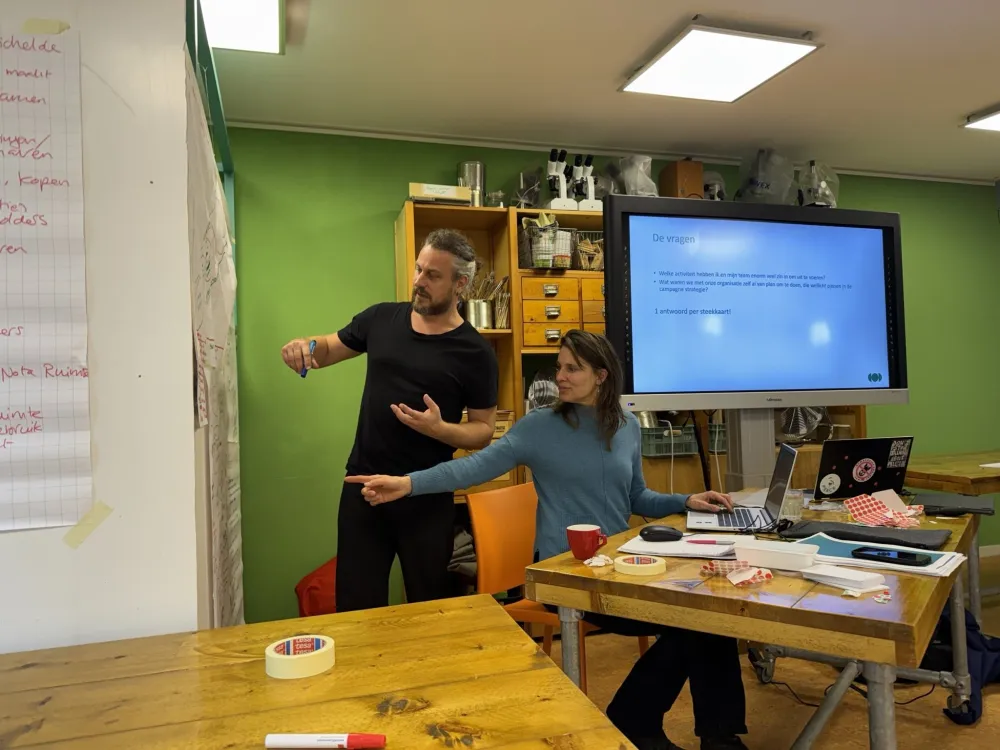
That is why our support starts weeks before the actual strategy day. We gather input through one-on-one conversations, digital questionnaires, and exploratory discussions with key players. This creates a great deal of content and context before the day itself.
During the strategy day, we focus on two core tasks:
- Stimulating creativity and making connections visible
- Exploring possible directions and shared priorities
We work with formats that create space for broad thinking while also inviting clear choices. A central question in this is: what are we truly excited about together?
After the strategy day, we work with S&L to build a concrete proposal. This usually results in a limited number of clear scenarios that the coalition can position itself in relation to. The approach remains fast and light, while we stay aware of the risk of limited support. That is why, during the day, we get as many people as possible actively involved and ensure that themes that generate a lot of energy also visibly return in the strategic options.
“Choices gain meaning when people get to know and appreciate each other as individuals and as organizations.”
The real issue: structure and mandate
In many processes, the substantive strategy is put down on paper relatively quickly. The real work begins with the structure of the coalition.
A few key questions keep recurring:
- Who takes on leadership, and what does that look like?
- Which decisions do we make together, and which decisions does the lead take?
- What happens when time pressure or external pressure increases?
- How does communication run between management teams and between teams?
- How do you involve people who were not at the table and who will soon help implement the strategy?
In that respect, we see striking situations. In one coalition, hundreds of emails circulate each week; in another, a shared Teams channel remains empty. In both cases, information gets blocked.
That is why we often link the strategy day to concrete structural advice: feasible agreements on roles, decision-making, consultation structures, and communication. This gives the strategy a solid framework in which to take root and be put into practice.
Strategy is shared human work
Strategy in a coalition rarely develops linearly. A clear document helps, as part of a bigger whole. Strategy lives in encounters, meetings, efforts on the ground and in the way people take up leadership.
For us at S&L, supporting a coalition is one of the most demanding forms of work. At the same time, we repeatedly see the potential when organizations join forces around themes such as climate, health in the Global South, biodiversity, rights for undocumented people or the fight against the far right.
Coalitions are difficult. But when they succeed, they are the most powerful thing there is.