“Too much” is not an abstract category. It is the concrete moment when the sum of the reactionary pressure from outside (politics, media, funding, government, market) and the idealistic pressure from within (values, participation, leading by example) becomes greater than the absorptive capacity of your organization. Then you get delays, fatigue, and “parallel-itis”: starting a lot, finishing little. Idealism becomes a burden and realism becomes cynical.
We are writing this because, with S&L Strategies and Leaders ourselves, we have stood on that boundary. We grew quickly due to an increase in client requests and a shift in those requests: less need for team and culture programs, more need for structure, governance, and financial management. At the same time, internally we wanted to realize the full potential: every employee becomes a shareholder, sociocracy introduced, steward-owned become, internationalize and diversify the team.
Each of these are defensible choices. But: all at once was too much. That is why we are sharing how we adjusted course, including tools you can start applying right away.
This article is about dosing more intelligently: we show how to recognize pressure, assess capacity for change, unite idealism and realism, and phase your trajectory without ‘losing your soul’.
The reactionary pressure of the outside world
Shifting context
The outside world rarely leaves organizations in peace. Budget cycles tighten and loosen, economic winds shift faster than we can keep track of calendars, and political rhetoric polarizes the debate about the importance of a strong civil society. On top of that, public attention to social and ecological issues is under a magnifying glass. One week there is applause for climate action and inclusion, the next week criticism erupts; sometimes well-founded, sometimes purely strategic. This force field influences direct choices: funding, deadlines, reporting, and focus.
“This piece is not about tempering ideals, but about dosing them more intelligently.”
For many mission-driven organizations, this context translates into shorter time horizons and heavier accountability pressure. Whereas in the past most of our conversations were about team dynamics, culture, and leadership style, we now see a clear shift in emphasis toward structure (roles, authorities, governance) and finances (scenarios, cash management, impact measurement tools linked to the budget). That is not a problem in itself (yes, it can even be healthy), but it does change what your organization needs to be able to carry.
The effects on steering and behavior
External pressure often works like adrenaline. It makes us more alert and faster; we put our best people on fires, we redraw roadmaps, we deliver “quick wins”. But adrenaline is an emergency fix, not a diet. Anyone who relies on external triggers for too long ends up in abrupt course changes: each time adjusting just enough to get through the next quarter, without addressing the underlying problem. You see this reflected in colleagues’ calendars full of temporary projects that have become permanent, and in meeting rhythms that are filled not with content but with urgency.

The deeper pitfall is that organizations then start organizing reactively. Reporting takes the place of strategy. A multitude of rules swallows up the conversation about meaning. And because the pace is high, a reflex emerges to act more top‑down (“we’ll just decide it this way for now, we’ll explain it later”). That is human, but macroeconomically unsustainable: participation then becomes a façade, and people either disengage or rush along without real support. In both cases, your real capacity for change decreases, no matter how fast you run.
The idealistic pressure of the inner world
Leading by example is hard work
The inner workings of mission-driven organizations are not neutral. We want to embody the new world in how we act: we choose participation, transparency, shared ownership, sociocratic decision-making, sustainable choices, inclusive practices. We want our structure and strategy to reflect what we preach in the world. Rightly so. But that comes with participation pressure and value consistency that do not always fit the stage of maturity of the whole.
Idealistic employees ask for more say, faster alignment of policy with values, and visible gestures (“if we mean it, then...”). Teams are often right about the direction and underestimate the effort needed to achieve a solid result.
The pitfall is a normative lock-in: we do things because they feel “pure,” not because they fit “what we can handle now.” Strategy is then sometimes shaped primarily by values, and not by feasibility and sequence. The result: many noble initiatives competing with one another for the same limited attention.
S&L as an example: the right things, but too much at once
We chose sociocracy, we worked toward steward‑owned ownership, opened an international line, wanted to improve our compensation model, planned to grow, and also intended to take major steps in making the team culturally diverse.
We did this because we believe in shared ownership, in decision-making close to the work, in care for people, in the importance of reflecting society as a team, and in scalable impact across borders. We still stand by that.

Only over time did we see that the parallel workload was too high. Role clarity was not keeping pace with the number of changes. Financial governance was running ahead of the decision-making rhythm. And our internal communication sometimes lagged behind events: something that feels especially painful when ambitions are transparent.
The lesson was not: “be less idealistic”. The lesson was: pace idealism with realistic capacity for change. Not either‑or, but both‑and. And that starts with being able to see and name your capacity.
The absorptive capacity of an organization is not a mystical number.

Accurately assessing capacity for change
An organization’s absorptive capacity is not a mystical number. You can make it concrete by looking at three dimensions:
- Strategy: is the direction clear? Is there a well-defined problem/target group? Can we make choices and stick to them despite noise? Is there a cadence for planning and adjusting?
- Structure and governance: are roles, authorities and responsibilities clear? Is financial management mature enough (scenarios, budgeting, risk radar) for the ambitions? Is there a decision-making rhythm that matches the speed of change?
- People and culture: do leaders and teams have the necessary skills (subject-matter, change management, relational)? Is there psychological safety to learn? What is the state of energy, focus and mutual reliability?
For each of these dimensions, you can describe maturity levels. Not to “rank”, but to inform decision-making. A strategic sprint without a governance foundation is vulnerable. A cultural intervention without role clarity is frustrating. A financial redesign without the human work is cold and short-lived. By balancing the three dimensions, you build absorption: the capacity to cope with change, not just to want it.
Greiner: growth phases and typical crises
The Greiner model helps to situate change capacity within the growth phase of your organization. In short:
- Growth through creativity → leadership crisis: pioneering works, but it lacks leadership; need for direction and basic processes.
- Growth through direction/guidance (leadership) → autonomy crisis: strong guidance delivers results, but stifles initiative; need for delegation and local decision-making space.
- Growth through delegation → control crisis: autonomy grows, but coordination and control lag behind; need for a system of control and information.
- Growth through coordination → bureaucracy crisis: procedures help, until they become stifling; need for collaboration and flexibility across teams.
- Growth through collaboration → consultation crisis: collaboration is strong, but further growth requires new boundaries or partnerships.
- (optional) Growth through entrepreneurship/alliances → identity crisis.
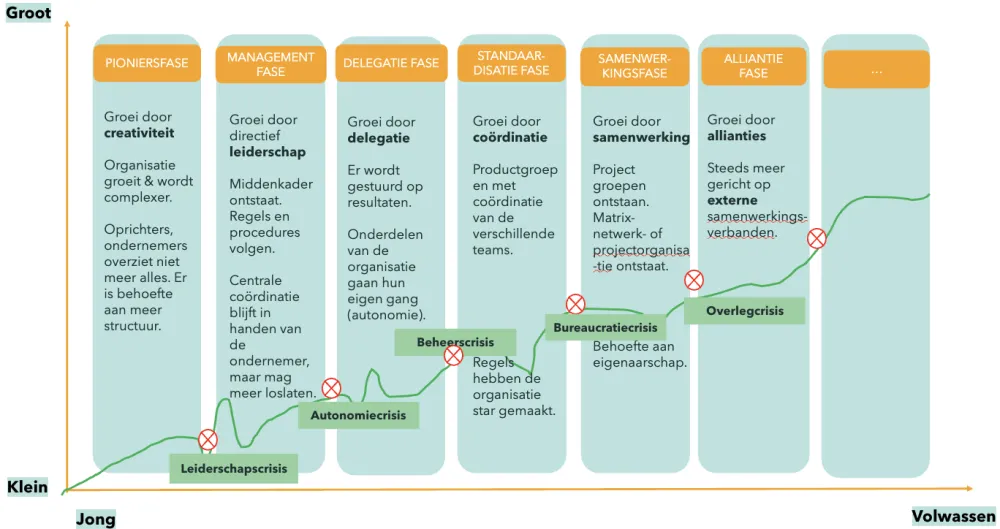
Why is this relevant? Because the type of crisis that belongs to your phase determines your change priorities. An organization at the end of Direction must learn to delegate before it can effectively sustain sociocracy. An organization in Delegation needs coordination to keep internationalization from derailing. Many “too much” experiences arise from skipping the next appropriate step in exchange for an attractive but more complex experiment.
Where do you stand?
The quickest reality check: describe your last six months of changes. Which were strategic, which structural, which people-/culture-oriented? Which have been completed (in process and behavior), and which have been announced but not embedded? Put your Greiner phase alongside that. If you see patterns of parallel major changes without completion, and your phase points to an impending crisis (e.g. need for coordination), then your pressure index is probably higher than your capacity. That is not a reproach; it is an invitation to pace it.
Sometimes it helps to take a moment to look in a mirror. That’s why we developed a short scan: (“Is your organization ready for major change?”)
Uniting idealism and realism
Have you ever put your ideal into a single sentence? Not as marketing, but as a governance anchor. What do you want to be that you are not yet today? “We want to be a steward‑owned organization with participatory decision-making, healthy financial governance, and international clout.” Fine. But then comes the follow-up question: which step belongs now, which later?
Making the ideal explicit prevents two reflexes: (1) making excessive demands of the present (“everything at once, because it belongs to who we want to be”), and (2) making insufficient demands of the future (“we’ll do it someday”). A well-formulated ideal creates distance: far enough to provide direction, close enough to phase it.
Think in Minimal Viable Change (MVC)
We know the concept of Minimum Viable Product (MVP). Apply that way of thinking to change: Minimal Viable Change (MVC). What is the smallest version of steward‑ownership that delivers value and provides learning data without paralyzing your organization? What is the smallest step toward sociocracy that improves decision-making and makes it understandable ? Think of pilots with clear scope, timing, and evaluation criteria. MVC forces you to dose: first the basics, then broadening, then deepening.
Portfolio thinking and rhythm
Instead of a long list of separate projects, you build a change portfolio. You divide that portfolio into three waves of 90 days. Each wave contains a limited number of major initiatives plus a few medium-sized/small ones. Per wave you have clear goals, owners, RACI (who decides, who advises, who is informed), and a demo moment at the end: what is actually different in systems, behavior, and results?
The rhythm is simple: monthly steering session, operational synchronization every two weeks, weekly team check-in. Not to have more meetings, but to safeguard decision-making and learning . If something makes no progress for two sprints in a row, it goes on stop or later. Strict? Yes. But better a clear no than a permanent maybe.
Take the Change Capacity Scan
You can of course talk endlessly about pressure to change and absorption, but sometimes it helps to take a moment and hold up a mirror to it. That’s why we developed a short scan: “Is your organization ready for major change?”
In ten minutes, you map out how strong your capacity for change is today — not based on gut feeling, but on four tangible domains:
- Processes & systems: how smoothly does the organizational infrastructure run?
- People & culture: how open are employees to learning and experimentation?
- Financial scope: how much room is there to invest in innovation?
- Development level: which growth phase are you in as an organization, and which associated “crisis” from the Greiner model is emerging?
Based on your answers, the tool links an overall score to one of five scenarios. Each scenario describes how you deal with change today and gives you advice on what you should or should not do now. The aim is not to judge, but to reflect.
Most organizations slightly overestimate their capacity for change, rarely out of arrogance, but out of hope. This scan helps ground that hopeful view in reality. It shows where energy is leaking, where structure is lacking, and where resilience is greater than you thought.
Take ten minutes, answer honestly, and discover how truly change-ready you are.
S&L supports and advises
With our self-test you gain insight into your own capacity for change. Prefer a real person after all? Be sure to contact Jeroen Robbe, Koen Van Overmeiren, Siska Van Houtte or koenraad Depauw.










