Mamdani’s political agenda, rooted in the needs of ordinary New Yorkers, set just about the entire political establishment and almost all billionaires against him. That opposition mainly ran a classic campaign: with video ads, often laced with false claims and insinuations, aimed at damaging Mamdani. He was supposedly a young, inexperienced whippersnapper, would “wreck the economy with his Marxist ideas” and even “support terrorists”.
How do you take on a constant stream of those kinds of ads? Mamdani’s team did it with class. Yes, the man himself is charismatic and an undeniable political and rhetorical talent. He was also surrounded by a formidable, creative communications team that, via the campaign’s social media channels, painted a picture of the man and his ideas that was radically different from the one in the orchestrated attacks.
Still, the difference was made above all on the streets, by focusing on the principles of “community organizing”. Strikingly: Barack Obama and Zohran Mamdani both have a background as an “organizer”.
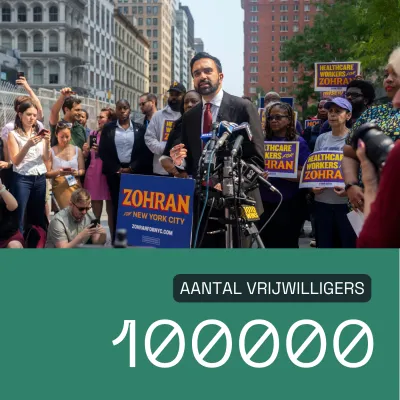
The very high volunteer numbers are typical of what is called “big organizing”, a rapidly scalable version of community organizing that uses digital tools to bridge distance and make the coordination of and communication with larger groups easier.
The recipes for this first came to attention during Barack Obama’s first presidential campaign. Not Joe Biden or Kamala Harris, but Bernie Sanders subsequently organized his unexpectedly strong campaigns in the same way, by mobilizing enormous numbers of volunteers.
Also typical of big organizing: a focus on recruiting a mass of small donations, rather than on gathering resources from a few very large donors. In this way, voters also know that the candidate stands up for all of them and has not been “bought” by wealthy people or business leaders who later want something in return.
The principles of big organizing were described in the book “Rules for Revolutionaries: How Big Organizing Can Change Everything” by Becky Bond and Zack Exley, both involved in designing Sanders’s presidential campaign.
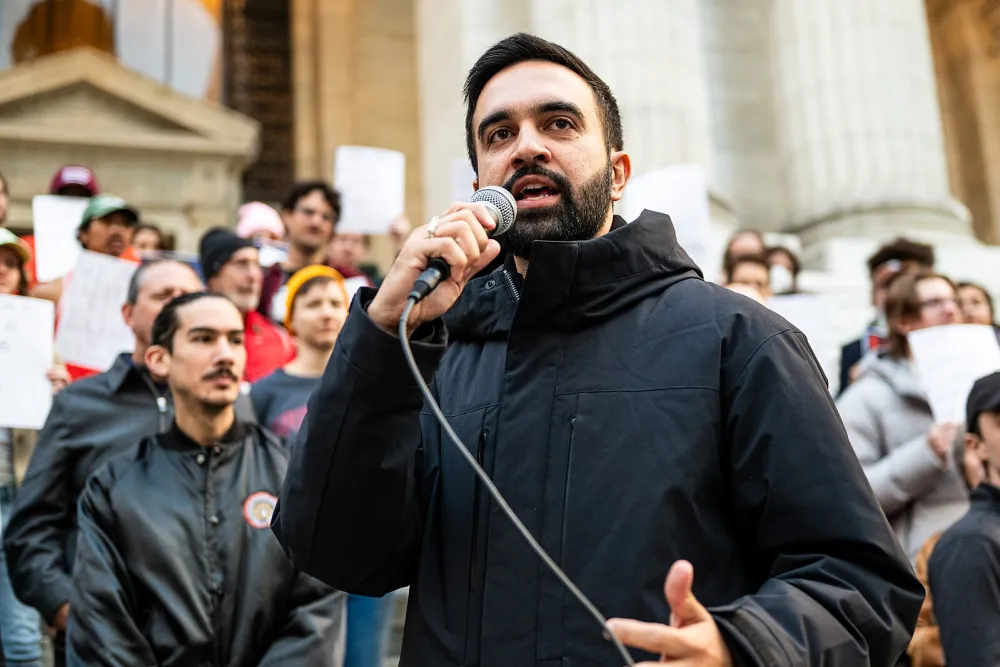
The art of persuasive organizing is becoming ever more refined, as was also the case with Mamdani’s campaign. Without that grassroots campaign, he would never have won with the highest turnout figures since 1969 and with more than 50% of the votes cast.
In the end, he therefore won more votes than a three-time former governor of New York State, Andrew Cuomo, and the Republican candidate Sliwa combined. And yet in February of this year, Mamdani was barely polling at 1%. He was still a noble unknown to the world and to New Yorkers alike.
5 lessons in recruitment-based organizing
Below are five lessons we can learn from Mamdani’s masterclass in recruitment-based organizing, a way to scale up your campaign’s effectiveness quickly and efficiently. These are lessons that are relevant not only for progressive parties, but also for civil society organizations that want to build support and power around an agenda that is widely shared and deeply felt.
1. Listen before you start talking
Mamdani’s first campaign videos already illustrated that this campaign was not a traditional election campaign. He did not immediately take to the streets with an election platform; instead, you saw how he engaged in conversation. And above all: that he listened. He questioned people on the street, taxi drivers, workers, small business owners, and so on.
New York has 8.5 million inhabitants and is the economic heart of the US. The cost of living there is extremely high and continues to rise. Mamdani heard New Yorkers share their frustrations. And no, those did not turn out to be about whether Israel should remain a Jewish state (the pet issue of that other candidate, Cuomo) or about “how woke education is allowed to be.”
Several themes keep recurring in residents’ often painful stories. Rents are rising at breakneck speed, and those who work in the city increasingly have to move because housing is becoming unaffordable. Public transport is also expensive, unsafe, and unreliable, making life even harder for commuters from outside the city. Add to that the high cost of groceries and childcare, and many New Yorkers see no way out other than leaving the city or falling into poverty.
“Broadening your base is not enough. Because how on earth do you organize over 100,000 volunteers? With a large cadre of paid staff to direct them? Forget it. Not if you're the progressive candidate.”
2. Make sure your political agenda offers an answer to a widely shared and deeply felt pain among people
In an organizing campaign, listening is not performative. It is not pretending to listen only to make your point as quickly as possible. It is truly about listening in order to map shared needs, on which you can build a shared struggle – or in this case an election program.
Mamdani’s program is not based on the work of a think tank or the result of lobbying groups’ tug-of-war. His central demands and policy proposals stem from the pain that New Yorkers shared during conversations he and his supporters held at the start of the campaign.
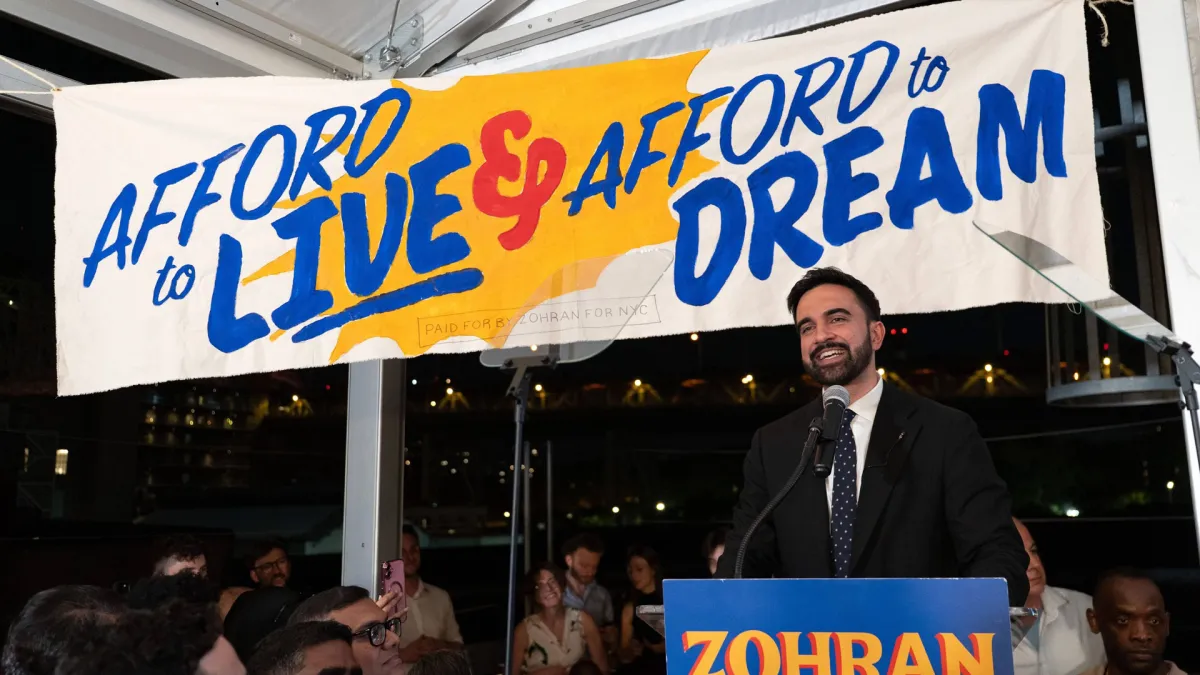
The most visible election promise: affordable housing by freezing rents. But Mamdani also strongly focused on additional investments in free, safer and fast public transport and on offering affordable food through grocery stores set up by the city itself. These are some of the key issues that each made the difference. Mamdani repeated the promises again during his victory speech on election night. A speech in which the ordinary New Yorker was once again at the center: “We will fight for you, because we are you.”
On election day, it became clear that the Mamdani campaign had truly given people something to vote for. CNN’s exit poll immediately after the election showed that for 86% of Mamdani’s voters, their vote was clearly for Mamdani and his policy proposals, rather than against another candidate. For Cuomo, only 46% voted for the candidate because of who he was or because of his program.
The same exit poll also asked about the qualities that stood out in the candidates, according to their voters. For Mamdani: “he brings much-needed change” (41%) and “he stands up for people like me” (29%). Cuomo mainly had to rely on his experience (50%), because only 10% of voters believe he would stand up for people like them.
3. Broaden your base: recruit supporters and give them a role
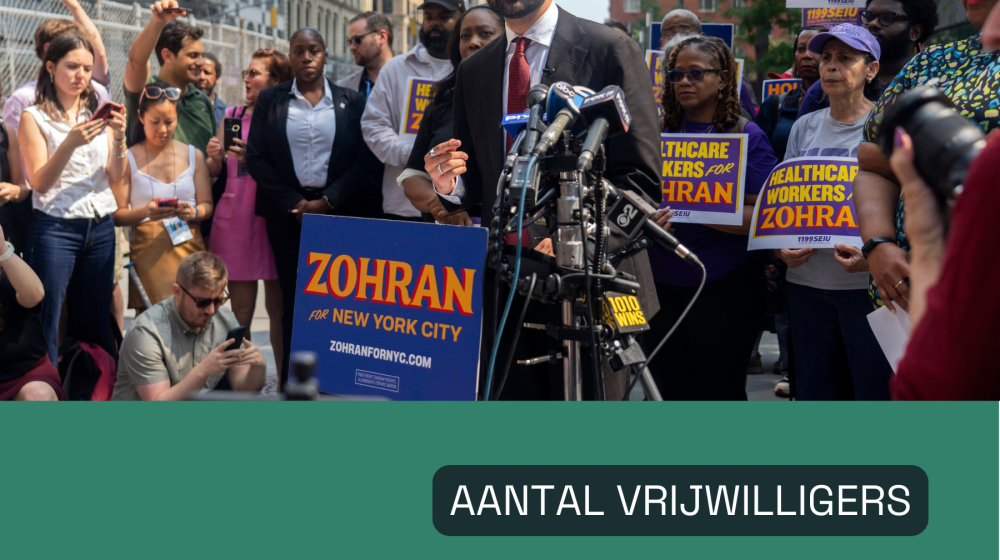
In the run-up to the Democratic primaries in June, Mamdani could already count on 50,000 volunteers. An initially small but well-oiled campaign machine brought them together in just over half a year.
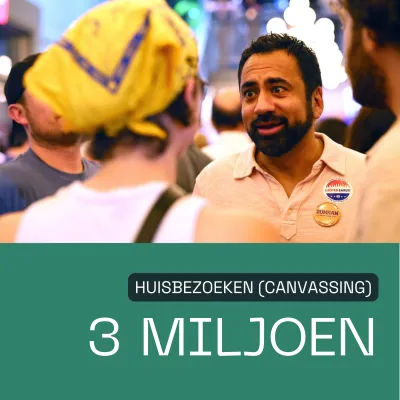
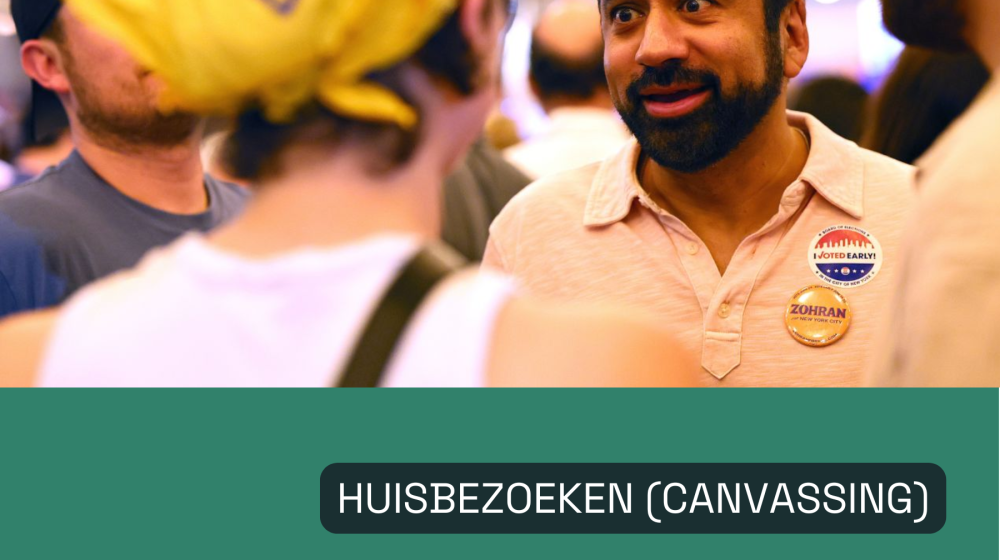
Those volunteers were deployed for activities such as canvassing, going door to door in a neighborhood to listen to people’s pain and frustrations and link them to their candidate’s agenda. By the June primary, no fewer than 1.6 million doors had been knocked on. Mamdani’s team also focused on phone campaigning, enabling supporters who lived outside New York to contribute as well.
In the final week of the campaign, the number of active supporters had risen to more than 100,000 volunteers. Ultimately, that unprecedented effort set another record on the very last day before the election: in the end, doors were knocked on 3 million times. Unprecedented in mayoral elections in the city. The number of phone calls is no less spectacular: over the course of the entire campaign, potential voters were ultimately called 4.4 million times.
4. Strengthen your base: grassroots leadership
Broadening your base is not enough. Because how on earth do you organize more than 100,000 volunteers? With a large cadre of paid staff directing them? Forget it. Certainly not if you are the progressive candidate. Of course, there are paid staff in such a campaign. But there are a few dozen of them, not hundreds.
Leadership development is the beating heart of all organizing campaigns. It is not about a classic top-down interpretation of leadership, but about an approach that calls on the leadership of dedicated volunteers, who, with minimal training from a small cadre, get to work themselves and are encouraged to take on a larger role, including responsibility for a new batch of volunteers.
Tascha van Auken, the organizing director of Mamdani’s campaign, described it this way: “Leadership is not about having all of the answers, it’s about the willingness to step into the unknown and inspire others to imagine something better.”
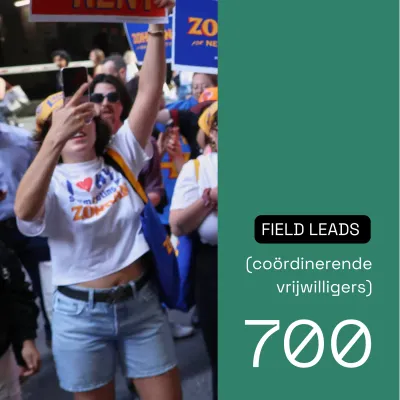
One of the main forms of “grassroots leadership” in this campaign was exercised by the “field leads” who would prepare and coordinate other volunteers when going door to door in a neighborhood. Many of these leads did one shift per week. By the end of the campaign, there were 700 of these super-volunteers, who together formed the backbone of the campaign on the streets.
5. Broaden your base further through smart alliances and involve their supporters too
Mamdani and his closest allies from the DSA (Democratic Socialists of America) drew lessons from previous unsuccessful attempts or successful campaigns on a smaller scale. They learned that you cannot win against such powerful opponents alone.
Mamdani entered into an alliance with another mayoral candidate, Lander, who himself has a Jewish background. That was not insignificant, given that his outspoken support for the Palestinian cause made him a target of unfounded accusations of antisemitism.
In the New York primaries, a system of ‘ranked choice voting’ applies, in which you also indicate a second and third preference, so your vote still has an impact if your candidate is eliminated. The alliance with Lander meant that both Mamdani and Lander asked their supporters to put the other in second place.
Important anti-Zionist Jewish activist groups such as Jewish Voice For Peace also endorsed Mamdani’s campaign and leadership. They too set up teams that went door to door, with a focus on neighborhoods with a strong Jewish presence, to speak directly to New Yorkers and combat the disinformation fueled by the disinformation campaigns of Cuomo and others.
The alliance-building, however, was not limited to other progressive candidates or Jewish activist groups. The local branch of the youth climate movement Sunrise Movement and the influential Working Families Party also gladly joined in. The latter mobilized, for the primaries alone, more than 1,000 volunteers.
In addition, several union locals expressed their support for Mamdani. During the primary, it was still limited to some of the most progressive branches, but after the primaries, when people really began to believe in Mamdani’s chances, he continued building a stronger alliance, with more unions endorsing his campaign. Even less progressive Democrats felt compelled after the primaries to express their support.
Conclusion: learn recruitment-based organizing yourself and give your campaigns a boost
Mamdani’s successful campaign did not come out of nowhere. He stood his ground and seemed tireless in fending off political attacks and repeating his program, in which so many New Yorkers could see themselves. He painted a story of hope reminiscent of Obama’s first campaign, but with content that was much more progressive. Always with a smile, always with full conviction.
But it would be a painful mistake to attribute his campaign success to that alone. While Andrew Cuomo based his campaign on the power of organized money, Mamdani’s strength lay in organized people. This was also emphasized several times by both Mamdani himself and other speakers from the campaign team at the victory rally.
Both Mamdani and the DSA have built up years of experience in recruitment-based organizing. It is not the fastest route to success, but it is one that proves its effectiveness time and again. Not only for political parties, but also for civil society organizations. It was, for example, a key to unprecedented success for the militant tenants’ union KC Tenants in its struggle with large rental companies. The method also allowed the youth climate organization Sunrise Movement to build powerful chapters across the country in no time, and enabled Jewish Voice for Peace to stand up for the first time against the dominant Zionism in American politics.
Modern community organizing has evolved a great deal since the time when it inspired early community development work in our country from the 1970s onward. Gradually, the methods are also being rediscovered here and taught again: in search of stronger campaigns, supported by a growing base.
When does a powerful organizing strategy end? Well, if you approach it smartly, never. Every campaign offers you an opportunity to lay the foundations for the next, more ambitious victories. Those who organize smartly and persevere can even use an experience of defeat to strengthen their base by further connecting the people they mobilized to their cause. Meanwhile, you refine the methods. “Never a failure, always a lesson,” as organizers sometimes sum it up.
The fact that Obama dismantled his organizing department after his first election victory may well have been his biggest mistake. He lost the organized support of people to push through his more ambitious goals with support from the outside. Mamdani’s campaign team has also learned this lesson and was clear on election night: this time, there will be no demobilization.
Want to get started yourself?
Are you also inspired by Mamdani’s strong campaign? Do you want to gain more insight and get tips on how to apply his principles in your organization’s campaigns? Then come to Jeroen’s free webinar: You don’t win alone. Behind the scenes with Zohran Mamdani.
Those who want to delve deeper can also register for the next edition of our “recruitment-based organizing” training course. Please note: places are limited and this training course fills up quickly!