It has been quite some time now since I first heard this theory: you only need 3.5% of the population to change society. Hopeful! But is it true?
Usually not, then.
Where does that idea come from?
The 3.5% theory is not some airy-fairy invention by a transition guru, but is solidly scientifically substantiated. Erica Chenoweth, an American political scientist specializing in civil protest and political conflict, studied more than 300 uprisings between 1900 and 2006 together with Maria Stephan. Their conclusion: no nonviolent movement failed if at least 3.5% of the population took part.
Applied to Belgium, that means: 400,000 active people. And yes, we have reached that number at least twice in recent history. The protests against nuclear weapons in 1983. The White March. More than 400,000 people in the streets. And yet painfully little changed. How is that possible?
What doesn’t add up?
Chenoweth’s research focused on dictatorships and authoritarian regimes, each time with the same stakes: power over a region or country. Not a societal debate about nuclear energy or child abuse in a parliamentary democracy, but a struggle for power itself.
So the theory does hold true in dictatorships, but not beyond them.
The state and the monopoly on violence
Every state has the monopoly on violence. In exchange, it guarantees order and security and enforces compliance with the law. Belgium has around 70,000 police officers and soldiers serving that purpose. That is barely 0.6% of the population.
The rule is simple: the more legitimacy political power enjoys, the fewer people are needed to maintain that monopoly. The fairer and more just the laws are, the more quickly they are accepted by the population. And therefore: fewer police.
In a dictatorship, that works exactly the other way around. North Korea deploys 7% of its population as military or police. Cuba and Assad’s Syria: more than 2%. Russia: 1.6%. The US under Trump: about 1%.
Your father, your brother, your aunt
Why, then, is that 3.5% valid in dictatorships? Because the likelihood increases that the regime will have to use violence against its own bloodline, its own social network. Your father, your brother, your aunt, your best friend.
And that is exactly where the tension lies. When 3.5% of the population actively resists, and the army and police are ordered to strike them down, something crucial threatens to happen: the order is refused. It breaks.
Of course, it is often more complex. Dictatorships systematically divide populations along lines of ethnicity, class, tribe or religion. But the bottom line remains: family and social intermingling mean that, with a 3.5% active countermovement, there is a high chance that the apparatus of violence will seize up.
Too bad. Not relevant here
For us in Belgium and Europe, that logic does not apply. Fortunately: we do not live in a dictatorship (although in recent years we have seen a worrying strengthening of authoritarian politicians). But unfortunately: the 3.5% rule is not usable for our social and ecological movements.
And yet. Many movements use the rule as a strategic foundation. Wrong. Because even if you reach 3.5%, all that awaits is disappointment.
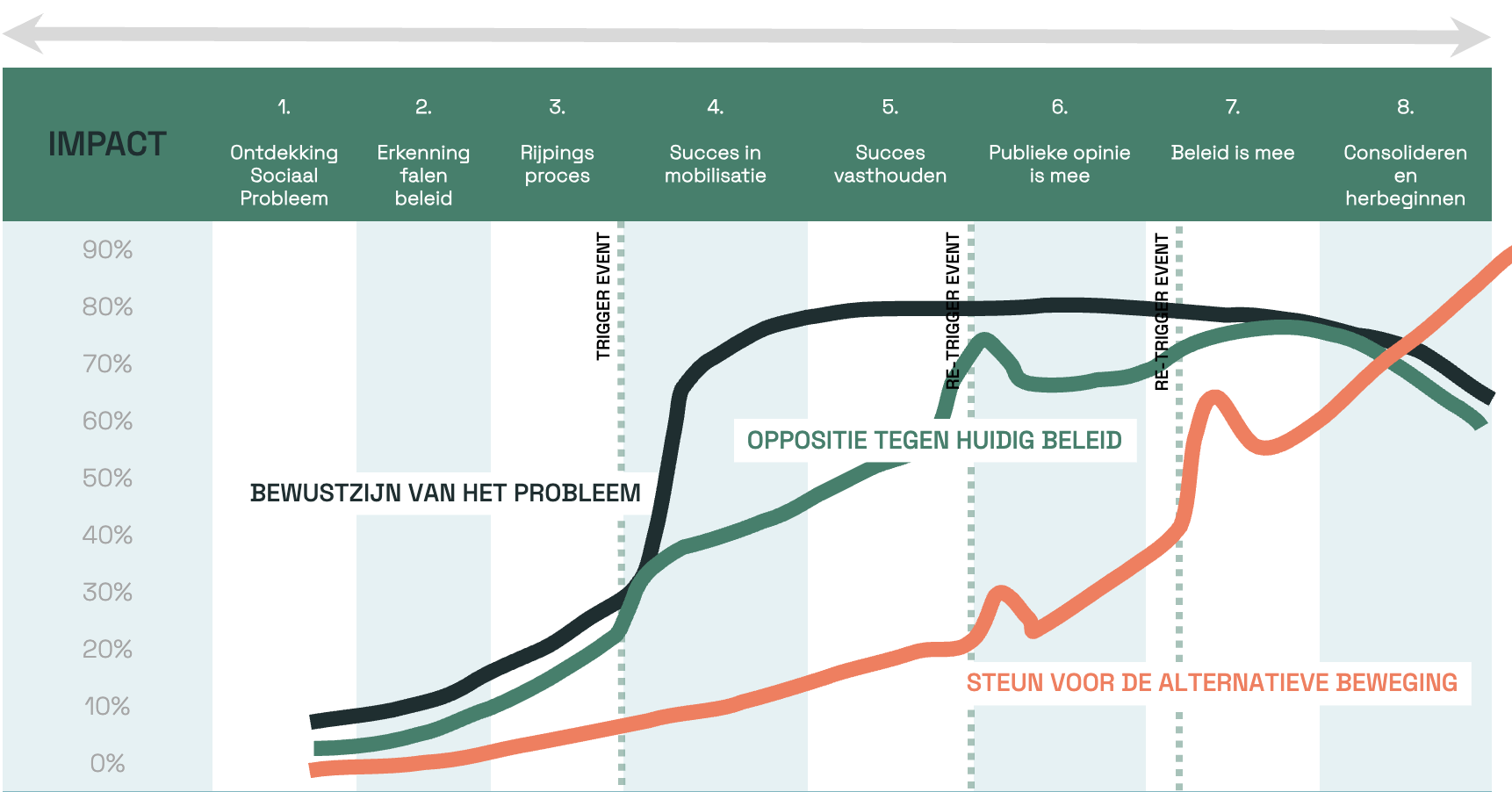
Better: Bill Moyer’s Movement Action Plan
At S&L, we therefore use a different compass: the work of Bill Moyer. His research looked at how social and ecological movements really broke through.
The core of his theory: every societal problem goes through eight stages before a political majority recognizes it and anchors solutions in policy. And in each stage, a movement has to do different things: in terms of actions, organizational form, funding, volunteers, service provision.
Stage 5 is particularly recognizable: the perception of failure. First disruptive actions, then mass mobilizations. But suddenly: silence. Media lose interest. The movement looks tired. Internal struggles rear their head: pragmatists versus fundamentalists, strategies going off in every direction. Sometimes the movement broadens, sometimes it simply stops. And yet… precisely then, success is often closer than you think.
The message is to keep going. But differently than in the “early days”.
Three questions for your movement
To know which stage your movement is in, you need to monitor three parameters closely:
- How large is the share of the population that recognizes there is a problem?
- How many people passively oppose the existing policy around that issue?
- How much public support does your alternative have?
Only when 25 to 30% of the population dares to speak out publicly in favor of the alternatives do you achieve a societal breakthrough.
Time for a different strategy?
Therefore: leave the 3.5% myth for what it is. Use a strategy that works. Use a strategy that takes account of stages, rhythm and support.
Do you want to know which stage your movement is in today? And free advice on what you need to do?










