Many civil society organizations are still operating on assumptions that worked perfectly well in calmer times. That government funding will more or less continue. That fundraising will automatically pick up again with enough effort. That wage costs may rise, but will remain manageable. That you can make minor adjustments without truly re-examining the architecture of your organization.
That is exactly where things are going wrong now.
The difficult thing about 2026 is not that everything is turning red. On the contrary: the CPB expects the Dutch economy to continue growing for the time being. But that same body also emphasizes that international uncertainty is high. At the same time, collective agreement wages in the first quarter of 2026 were 4.5 percent higher than a year earlier, inflation rose to 2.7 percent in March, consumer confidence fell to -30, and at the end of 2025 there were still 93 vacancies open for every 100 unemployed people. That is exactly the combination that affects civil society organizations: costs are rising, staff remain scarce, and the sense of financial security among households and donors is more fragile than a growth figure on paper suggests.
Pressure is also increasing on the public side. Municipalities are budgeting a combined 84.6 billion euros in expenditure for 2026, 5.8 percent more than in 2025, mainly due to rising social spending. And in some areas, cuts are already very concrete: the government had previously announced that from 2026 less money will be available for cooperation with NGOs in development cooperation. And organizations working on sustainability, nature and biodiversity, climate, or culture would do well to brace themselves too.
That is precisely why this is the moment to look not only at your budget, but at your organizational model. Because in a period like this, you rarely make it through with a few isolated measures. You have to go back to the fundamentals: how do you create value, how do you organize that work, and how do you finance it in a way that aligns with your mission and with today’s reality?
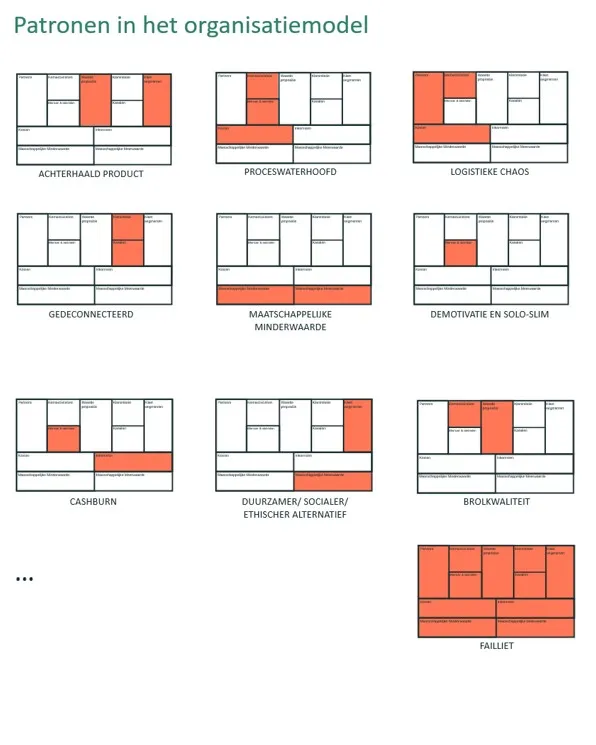
Your organizational model is the logic behind your organization
An organizational model is much more than an organizational chart. It is the underlying logic of your organization. Who exactly are you there for? What value do you add? Which activities are needed to actually deliver that value? Through which relationships, channels, and partners do you do that? Which people, systems, resources, and competencies do you need for this?
Many organizations know their annual budget better than their own model. They know what comes in and goes out, but have less insight into the assumptions behind it. Which activities actually require too much capacity. Which projects mainly add complexity. Which teams or layers of consultation mainly cause coordination costs. Which revenue sources seem attractive, but contribute little net value because they consume so much internal time.
That is exactly why this exercise is so important. As long as you only adjust the knobs within the existing model, you continue optimizing something that may no longer be fundamentally right. Then you save a little on individual items, while the real costs are embedded in the structure itself. Or you chase additional income, while your model is not designed at all to support that income in a healthy and sustainable way.
A good organizational model forces you to see both sides at the same time. On one side is everything that costs money: people, systems, processes, governance, housing, support, coordination, implementation. On the other side is everything that makes income possible: grants, gifts, donor relationships, members, clients, paying participants, partnerships, sponsorship, or other forms of value creation. Only when those two sides align does financial calm emerge.
First lever: redraw your structure
The first reflex under financial pressure is often: where can we cut? But that is rarely the best first question. The better question is: how is the work actually structured? Which activities are truly core? Which are supportive but necessary? Which do we do because we once started doing them, not because they are still strategic today? And where are we organizing ourselves in an unnecessarily heavy way?
That is where structural redesign often begins with simplification. Fewer exceptions. Fewer parallel tracks. Fewer projects that are all somewhat important. Fewer consultation structures without a clear mandate.
That usually requires a few firm choices.
The first is portfolio choice. Not everything that is valuable must also continue to be done by you. Some activities fit your mission, but no longer belong to your core delivery. Other activities once arose from enthusiasm or a funding opportunity, but today draw away a disproportionate amount of time and attention. A sharper portfolio not only lowers costs; it also increases focus.
The second is role clarity. In many organizations, overhead is not only in staff or management, but in diffuse ownership. Three people who are each half responsible for something often cost more than one person with a clear mandate. Teams that want to decide everything together also become expensive over time. Not only in money, but also in speed, energy, and execution power.
The third is process design. Standardize where possible. Centralize what does not need to happen separately everywhere. Do not digitize to be trendy, but to eliminate manual hassle and error-proneness. And take an honest look at supporting functions: where is proximity needed, and where is a shared, streamlined back office actually smarter?
“The key issue is not more money, but money that is a better fit.”
Second lever: rethink your financial model
The same principle applies on the income side: the key question is not more money, but money that is a better fit.
That is important, because the fundraising and financing context is not simply “bad,” but it is becoming more erratic. The study Giving in the Netherlands 2024 shows that in 2022, 5.3 billion euros was donated to charities, the lowest share of GDP to date, and that companies in particular gave less. At the same time, organizations affiliated with Goede Doelen Nederland report that private donations actually rose by more than 6 percent in 2024 to almost 1.45 billion euros, while 31 percent of that came from legacies. In other words: money is still there, but it is distributed more unevenly, is less self-evident, and more often depends on income sources with a different risk profile.
Organizations must therefore read their financial model more precisely. Not as a sum of line items, but as a mix of financing logics. Structural funding is different from project funding. A loyal monthly donor is different from an occasional giver. A legacy is different from a predictable annual contribution. Own income from training or services requires a very different organization than a model that relies primarily on public funds.
That means you need to assess every income stream against at least five questions.
-
Does this source truly align with our mission?
-
How predictable is it?
-
How much internal capacity does it take to acquire and retain it?
-
How dependent does it make us on one policy change, one major donor, or one market fluctuation?
-
And: does this source of income force us to do things that no longer really fit who we want to be?
There you often see interesting shifts emerge. Some organizations discover that they rely too heavily on project funding and are therefore permanently in production mode. Others notice that their fundraising from private individuals is not built on a sufficiently structural basis and depends too much on campaigns. Still others see that there is indeed room for additional income — think of training, paid programs, services, licenses, communities, employer contributions or strategic partnerships — but that these only work if they clearly align with the core of their value proposition.
For organizations that are highly dependent on government funding, that exercise is even more urgent. Not because government support will disappear everywhere tomorrow, but because priorities shift, schemes change and the pressure on public budgets is visibly increasing. In some areas, that movement has already been set firmly in motion, such as with the announced cut to cooperation with NGOs in development cooperation from 2026 onward. Anyone who does not yet have an alternative or supplementary income story by then makes themselves unnecessarily vulnerable.
A healthy financial model is therefore not only about growth. It is about resilience. About whether your income mix fits your identity, your rhythm, your capacity and your risks. And therefore also about the courage to stop accepting money that makes your organization look bigger on paper, but in reality makes it more fragile.
“The biggest mistake organizations make here is thinking that structure and funding are separate issues. They are not.”
A new financial model almost always requires a different organization. Those who want to generate more earned income usually need to become sharper in their proposition, customer or participant journey, pricing, acquisition, and delivery. Those who want to build up structural donors need different systems, rhythms, and competencies than an organization that mainly runs on subsidies. Those who want to work more through partnerships must invest in relationship management. And those who want to reduce dependence on project subsidies will also have to dare to standardize, prioritize, and sometimes scale back internally.
The reverse is also true. A lighter structure without a new revenue logic often results only in a slightly more efficient version of the same problem. And an ambitious new income plan without adapted teams, processes, and management usually gets stuck at good intentions.
The real task, then, is integration. Not: how do we save a little and find some extra money somewhere? But: which model will make our impact truly financeable and governable in the coming years?
What the board and management need to do now
For the board and management, this starts with five focused conversations.
Not the conversation about where there is still a little fat to trim. But the conversation about what we really must continue doing, what we can stop, what we need to standardize, which income streams we consciously want to strengthen, and which dependencies have become too risky. And also: which competencies belong with that new model? Because every serious financial path requires something in your organizational design. Different people, different routines, different management information, different choices.
This also calls for a different form of management. Less blindly focused on annual budgets. More insight into the underlying dynamics. Which activities truly contribute to your value? Which teams or programs require a disproportionate amount of coordination? Which income streams are stable, which are erratic, and which seem attractive but have a far too low net return once you factor in the internal effort?
Only then does financial strategy shift from the administrative back office to the core of governance.
Finally
This is not the moment to simply become a bit more frugal. This is the moment to design more intelligently.
Not every social-purpose organization needs to become bigger. Not every organization needs to become entrepreneurial. Not every organization needs to reorganize radically. But almost every organization now benefits from looking again at the logic beneath its work: how do we create social value, how do we organize that, and how do we finance it without slowly tying ourselves in knots?
In a time of rising costs, more erratic funding streams, and greater societal pressure, your organizational model is no longer a technical appendix. It is the place where your future is decided.