Leadership today takes place in a constant tension between urgency and insight. We have to put out fires and at the same time take the time to understand where the fire is coming from. In S&L’s training programs, that balance is a common thread: linking rational and analytical thinking with emotional intelligence and self-knowledge.
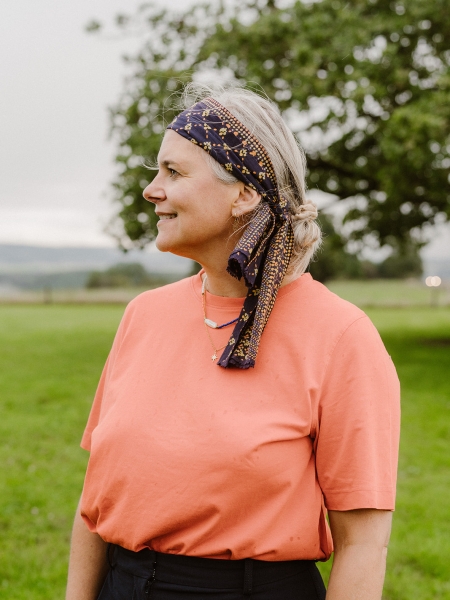
With Aurélie, one of the facilitators, we talk about what it means to learn to deal with complexity, emotions and change – and why leadership today has just as much to do with feeling as with thinking.
Aurélie, many organizations seem to be in a permanent state of crisis: something has to happen immediately. Why, then, is slowing down so important for good leadership?
Aurélie: Under stress, we quickly jump into “solve it now” mode. The chance of choosing the wrong solution is then high. It requires slowing down: zooming out, bringing in perspectives, understanding more deeply. At the same time, short-term action may be necessary. It is the combination that counts: putting out fires smartly and taking time to investigate root causes for sustainable solutions.
What exactly do you mean by that combination of thinking and feeling?
Aurélie: Integration is essential: head and body; you cannot work without your whole self. Thinking is perhaps the most powerful servant we have, but if we remain stuck in it, we cannot act or speak. You have to bring the rest of yourself along. And you do that by feeling. Emotions are there anyway: you can ignore them and then sooner or later they will catch up with you, or you can face them and include them in your thinking and actions.
Many participants initially look for concrete handles: tools, methods, checklists. How do you help them also engage in that personal process?
Aurélie: Acquiring knowledge is not the same as integrating it. You can only truly deal with your team, a change process, or societal challenges once you have integrated knowledge. That means: learning to apply concepts and making them your own by bringing in your vision, patterns, and motivations. Everything related to personal development requires a willingness to enter into a process in which you also look at yourself. These are often slower, emotional journeys.
Is the program therefore primarily a practice space, more than a transfer of knowledge?
Aurélie: Yes. We dive into people’s stories and cases and look for answers together. You will find part of it in theory, tips, and tools; a large part you will find within yourself. Not only information from the outside in, but also looking inward: insight, contact with your own needs and personal vision. A theory about leadership is never completely objective; it is shaped by the person in their specific context.
That requires trust and openness. How do you create an environment where participants feel safe enough to engage in that process?
Aurélie: Regardless of whether someone is a man or a woman: paying attention to how someone is really doing is the way to make progress as a team. Some people react uncomfortably to attention or concern because they are not used to it, while others immediately relax, as if they are relieved to be able to take off their mask. When you feel that you are allowed to say what you truly feel and need, it brings instant relaxation.
You spoke earlier about masculine and feminine energy. How does that play into all of this?
Aurélie: I notice that reason and discipline — often associated with “masculine” energy — are still valued more highly than emotion, intuition and care. Those values are still too often underestimated. There is progress, but in many contexts emotions or softer values are still seen as a weakness. Learning when to draw on which energy increases the effectiveness of your team and your mission.
Finally: what advice would you give to anyone considering embarking on a leadership program?
Aurélie: Invest in learning and development as a process without any guarantee of a specific outcome. The results are the sum total. “Make the path by walking it.” As a good leader, you learn to distinguish between what is technically solvable (quick wins) and what is adaptive: the complexity that takes time to feel, explore and remain curious about – even when you don’t know for a moment.










